D&D Games & Activities Singapore: 25 Ideas That Work 2026
Dinner and dance activities in Singapore make or break the second half of the night. Get the programming right and people are still on the dance floor at 11pm. Get it wrong and the crowd has thinned to half capacity by 9:30.
The challenge is real: you have 200 people in a ballroom who’ve just finished a three-course dinner. Some are in heels. Some barely know each other. Some are the CEO’s direct reports and are performing a version of themselves. Getting that room alive — and keeping it alive for four hours — takes more than a DJ and a lucky draw.
These 25 dinner and dance activities are ranked by when they work, not just whether they work. Because timing is everything.
The Engagement Problem: Why Most D&Ds Feel Flat by 9pm
There’s a pattern that plays out at corporate D&Ds across Singapore every year.
Cocktail hour: energy is high, everyone’s curious.
Dinner: conversation flows, the food is good.
Programme: awards, speeches, maybe a performance.
Lucky draw: brief spike of interest.
Dance floor: ten brave souls. Everyone else on their phones.
The problem isn’t the entertainment. It’s the sequencing. Most D&D programmes front-load all the “official” content — awards, speeches, management videos — then dump everything fun at the end when the crowd is tired and half-gone.
The fix is to distribute engagement throughout the night. Keep the crowd active from the moment they walk in.
Icebreaker Activities Before Dinner: Arrival and Cocktail Hour
The cocktail hour is the most underused hour in any dinner and dance programme. People are standing, they’re social, and they have no assigned seats or tasks. That’s an opportunity.
1. Giant game stations — Oversized Jenga, Connect Four, and chess create natural gathering points. People migrate toward them, start playing, and start talking. No facilitation needed.
2. Photo activation — A branded step-and-repeat backdrop with props. People take photos, share them, and the hashtag starts trending within the company’s internal channels before dinner even begins. Simple but effective for creating digital energy.
3. Lucky draw pre-registration with mystery — Don’t just collect tickets at the door. Create a pre-registration station where guests “unlock” a mystery prize category when they arrive. It creates anticipation before the programme even starts.
4. Digital trivia on arrival — A running trivia game on a screen that guests can answer via their phones. No facilitation needed; the leaderboard does the work. Seeded with company content so it’s relevant.
5. “Name the colleague” wall — A simple activation: 20 baby or embarrassing photos of colleagues (with permission, obviously) pinned to a board. Guests guess who’s who. Generates instant conversation and laughter during cocktail hour.
During-Dinner Table Games: Engagement Without Interruption
Table games work specifically because they don’t require the whole room to stop eating. They run at the table level, at each group’s own pace.
6. Table trivia cards — Cards on each table with 10 questions about the company, the year, industry trivia, or pop culture. Tables compete for the best score. A runner collects sheets after dessert. Announce results during the programme.
7. Table predictions game — Printed card: “Predict who at this table will: be first on the dance floor / win a lucky draw / give a speech they didn’t prepare / cry.” Sealed at dinner, opened at the end of the night. Almost always generates the most laughter of the evening.
8. “Did you know” company fact cards — Not a game but an engagement mechanism. Table conversation starter cards with genuinely interesting company stats, client stories, or “behind the scenes” moments. Works particularly well for companies with a long history.
9. Table-vs-table speed quiz — A live host runs 3 rounds of rapid-fire trivia during dinner (between courses). Tables answer on paper or via phones. Scores accumulate. Low-intervention, high-energy, and keeps the pace going.
Lucky Draw Formats That Actually Excite a Crowd
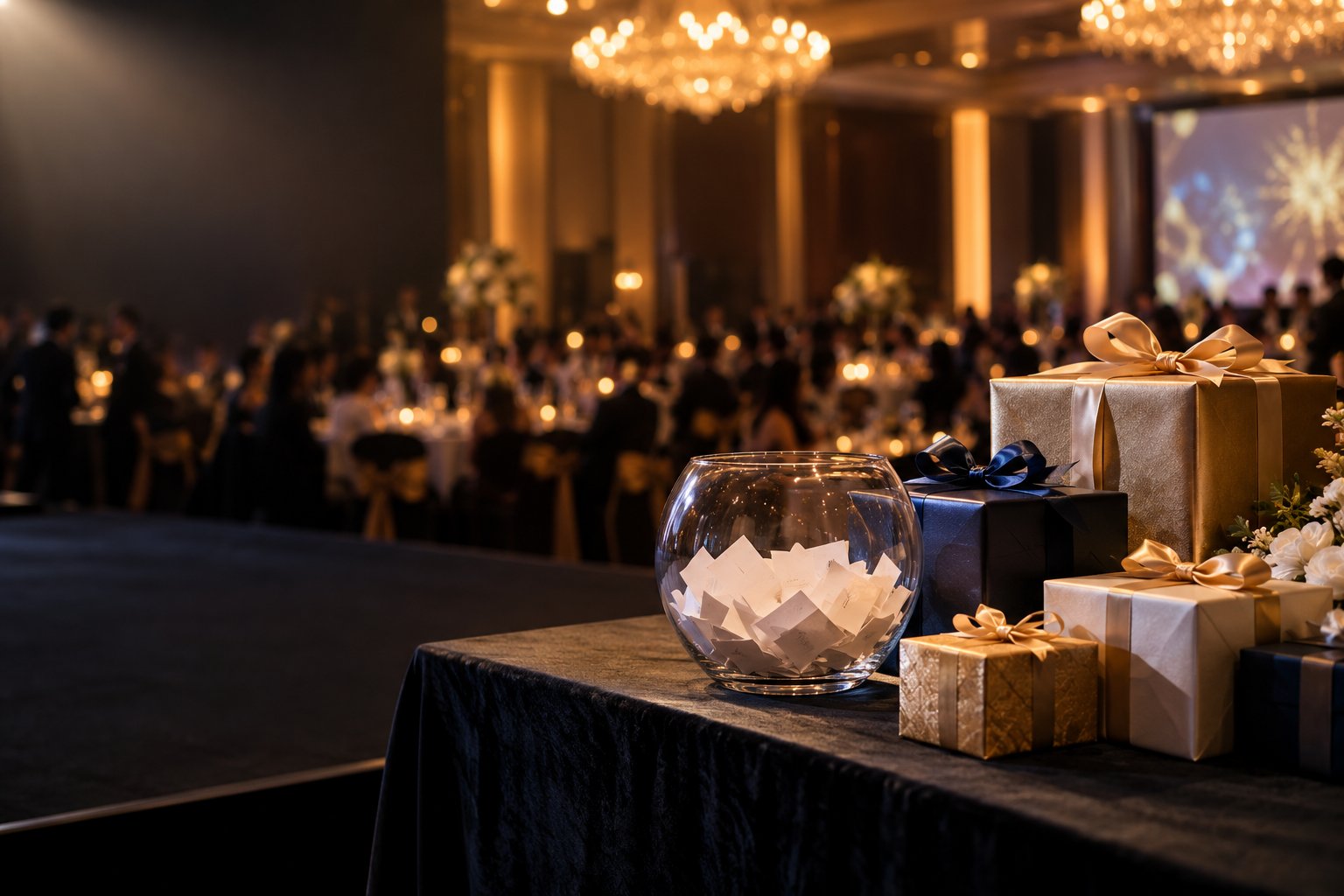
The standard lucky draw is: draw a number, call it out, person walks up, receives something, applause, repeat. Twenty iterations of that and the crowd is dead.
Better lucky draw formats:
10. Progressive reveal — Start with the smallest prizes and work up to the headline prize. Tension builds. Don’t do it in reverse (big prize first kills all energy for the remaining draws).
11. “Beat the MC” challenges — Instead of a straight draw, the winner must complete a mini-challenge to claim their prize. Answer a question, do 10 push-ups, do a celebrity impression. The attempt is always more entertaining than the prize itself.
12. Table knock-out — Each table starts with a token. As lucky draw numbers are called, tables with winning members keep their token. Last table standing wins a group prize. Suddenly everyone cares, not just the person whose number is called.
13. Lucky seat — Before the event, one seat at each table is marked underneath. At a designated moment in the evening, guests check under their chair. Creates a simultaneous, whole-room moment of excitement.
Trivia and Game Show Segments: Formats and Timing
A facilitated game show segment — 15–25 minutes, mid-programme — is one of the highest-impact additions to a D&D.
14. Company game show — Think The Price Is Right or Family Feud, reskinned with company content. Teams of 4–6 compete. A good MC makes this genuinely hilarious. Works for groups of 50–500.
15. “The Year in Review” trivia — Questions based on what happened at the company this year. Revenue milestones, new clients, team wins, funny office moments. Employees feel seen; leadership likes the recognition angle.
16. Quiz bowl with buzzer systems — Physical buzzers rented through an event company. Three teams, head-to-head. The tactile element (slapping the buzzer) generates a physical energy that phone-based quizzes miss.
Live Entertainment Options
17. Live band — The right band for a Singapore corporate D&D plays a mix of classic hits (70s–90s), current pop, and some Mandopop for the Chinese New Year season. Three sets across the evening, not one continuous performance.
18. DJ — Works better than a band for dance floor activation post-dinner. The best approach: live band for dinner service, DJ takeover for the second half.
19. Comedy set — A 15–20 minute stand-up set from a Singapore-based comedian. The humour has to be clean, culturally literate, and never punch at specific people in the room. When it lands, it’s the highlight of the night.
20. Magic and mentalism — A roving close-up magician during cocktail hour is consistently underrated. It creates natural clusters, generates conversation, and works for every demographic in the room.
Photo Booth and Digital Activations
21. AI photo booth — The 2026 version: guests take a photo, the booth outputs a stylised image (themed to the D&D concept) in seconds. People share immediately. Your event is suddenly visible to everyone’s network.
22. Green screen photo zone — A branded backdrop that composites guests into a themed scene. Slower to produce but the output quality is better for physical prints, which guests keep.
23. Live social wall — A display screen showing tagged photos from the event in real time. Incentivises posting; builds a shared live narrative of the evening.
Interactive Performances: Drumming, Dance, Specials
24. Drumming finale — Our drumming workshop format, adapted for D&Ds: guests are handed percussion instruments and perform a finale together. Takes 20 minutes to facilitate, creates the highest-energy moment of the night. Particularly effective for companies with a large Asian workforce where group participation over individual spotlight is culturally preferred.
25. Cultural performance segment — Chinese lion dance, Indian classical dance, or a fusion performance relevant to the company’s cultural mix. Works as an arrival or dinner entertainment piece. Signals cultural awareness and generates genuine appreciation from a diverse audience.
Post-Dinner Dance Floor Activation
The dance floor dies when the DJ starts before the crowd is warmed up. You can’t skip straight from awards to dancing — there needs to be a transition.
A few activation strategies that actually work:
The participation bait — A structured group activity (a dance tutorial, a line dance) that lowers the barrier. Once 30% of the room is on the floor, social proof does the rest.
The invitation from leadership — Senior leadership on the dance floor first. This one requires buy-in, but when the CEO is dancing, everyone else feels permission.
The right first song — Not something fast and aggressive. Something universally familiar, moderately paced, that makes people want to move. The crowd builds from there.
Games to Avoid (And Why They Kill Energy)
Some D&D activities are genuinely counterproductive:
Audience participation that singles people out — “Can I get a volunteer from Table 5?” creates visible anxiety. Some people will refuse, which deflates the moment. If you want participation, make it opt-in.
Speeches that exceed 3 minutes — Every additional minute after 3 is losing you audience attention. Brief is kind to the crowd.
Lucky draw as the only programme — It’s the most common D&D format and the laziest. Intersperse it with actual engagement activities.
Trivia where one demographic dominates — English-only trivia at a predominantly Chinese-speaking company. Questions about local culture in an expat-heavy team. Know your room.
How to Sequence Activities for Maximum Energy
Here’s a framework for a 5-hour D&D (7pm–12am):
| Time | Activity | Energy Level |
|---|---|---|
| 7:00–7:45 | Cocktail hour — giant games, photo activation, digital trivia | Medium-warm |
| 7:45–8:00 | Guests seated, welcome remarks | Settle |
| 8:00–9:15 | Dinner — table trivia cards, table games | Low-medium |
| 9:15–9:45 | Game show segment — MC-led company game show | High spike |
| 9:45–10:00 | Awards and recognition | Formal |
| 10:00–10:20 | Lucky draw rounds 1–4 (progressive) | Building |
| 10:20–10:35 | Live performance (drumming finale or comedy) | Peak |
| 10:35–10:50 | Lucky draw headline prize | Final spike |
| 10:50–12:00 | DJ, dance floor, open bar | Sustained high |
The principle: never let energy drop for more than 20 minutes. And never put the dance floor before the crowd is actually warm.
How Get Out! Events® Programmes D&D Entertainment
We don’t just supply games — we design the full evening arc. That means understanding your crowd (demographic, cultural mix, energy profile), building a programme that creates genuine momentum, and being on the ground to manage it when things run five minutes late (they always do).
If you’re planning a dinner and dance or annual dinner for 2026, talk to us before you finalise the programme. An extra hour of planning saves you a flat second half.
FAQ
What’s the single highest-impact addition to a D&D programme?
A facilitated game show segment, mid-programme. 20 minutes, MC-led, company content. It’s the activity that gets referenced in Monday morning feedback more than anything else.
How many lucky draw rounds should we do?
3–5 rounds, distributed across the evening — not all at once. Progressive structure (small prizes first, headline last). More than 8 rounds and the crowd stops caring.
Can we run dinner and dance games without an event company?
For groups under 50 and a simple programme — yes. For 100+ guests with multiple entertainment segments, you’ll want professional facilitation. The logistics of managing a room of 200 people while running a game show are real.
What activities work for a diverse, multicultural team?
Activities that don’t depend on language or cultural references. Giant games, drumming workshops, cooking competitions, and visual trivia work for everyone. Avoid word-heavy activities or humour that requires deep cultural knowledge.
How do we keep the energy going for a 5-hour event?
Sequencing. Distribute the high-energy moments across the evening instead of front-loading or back-loading them. And end with something worth staying for — a headline act, a drumming finale, or a headline lucky draw prize.