25 Team Bonding Activities in Singapore for Corporate Teams (2026)
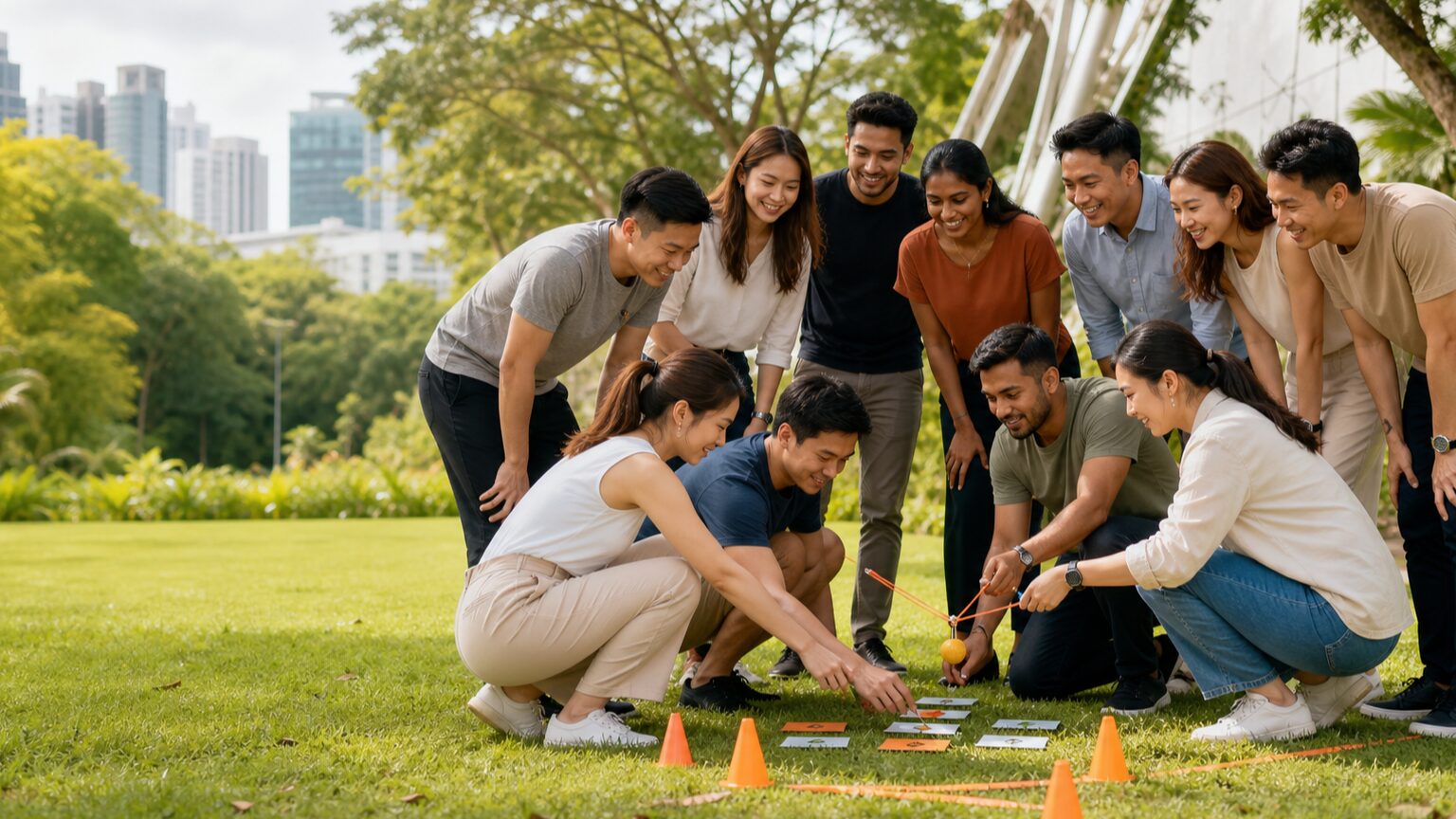
Budget doesn’t mean boring. Some of the best team building experiences in Singapore happen when you strip away the flashy venues and focus on what actually matters — people doing things together.
This guide covers 25 practical team bonding activities in Singapore across DIY, venue-based and facilitated formats, without losing the laughter, connection or debrief moments that make team building worthwhile. Whether you’re an HR manager stretching a quarterly budget or a startup founder trying to keep morale high without burning cash, there’s something here for every team.
Use our event budget calculator to get a quick cost estimate before you commit.
Quick shortlist: team bonding activities by objective
Choose the format around the outcome, group size and operating constraints, not just the lowest advertised price.
- Morale and social connection: scavenger hunts, food trails, art jamming and office games.
- Communication and problem-solving: escape rooms, Amazing Race formats, raft building and cooking challenges.
- Inclusive participation: paper engineering, museum trails, pottery and structured workshops.
- Large groups: checkpoint races, park challenges and scalable team tournaments.
For a professionally facilitated programme, compare our team building activities in Singapore.
Choose the right group activity before comparing options
A long list is useful only after the team agrees on the decision criteria. Use this four-step filter to remove unsuitable activities before requesting availability or proposals.
- Define the workplace outcome: choose one primary goal such as social connection, cross-team communication, leadership practice or recovery after a demanding period.
- Set participation constraints: record headcount, accessibility needs, physical intensity, indoor or outdoor preference, travel time and the maximum time away from work.
- Choose the delivery model: use DIY bonding for an already healthy team and a simple social goal; use professional facilitation when the brief needs structured collaboration, observation or a debrief tied to work.
- Compare complete scope: check venue, equipment, facilitators, safety planning, wet-weather alternatives, transport and catering separately so proposals are evaluated on the same basis.
Fast rule: if the outcome can be achieved by colleagues spending enjoyable time together, start with a simple bonding format. If leaders expect a behavioural or team-effectiveness outcome, select a facilitated programme with a defined briefing and debrief.
Why Budget-Friendly Team Bonding Isn’t Second-Rate
There’s a persistent myth in corporate Singapore that the higher the per-head spend, the better the team building. It’s not true.
What drives outcomes in team building isn’t the venue or the catering spread — it’s psychological safety, shared challenge, and the stories people carry back to the office. A premium venue does not guarantee connection any more than a simple park challenge does.
Research on team cohesion consistently points to shared effort and informal interaction as the strongest predictors of bonding. That means activities where people work together toward something uncertain, laugh at mistakes together, and talk without a PowerPoint in the room.
Budget activities often force creativity — and creativity, as it turns out, is exactly what team building needs.
That said, cheap activities done poorly still waste money and time. The tips at the end of this guide will help you structure even a free activity so it lands properly.
Low-Setup Team Bonding Activities
1. HDB Heartland Scavenger Hunt
Group size: 10–60 | Duration: 2–3 hrs
Build a clue-based scavenger hunt across any HDB estate — Tiong Bahru, Toa Payoh, Queenstown — and you’ve got a surprisingly rich activity. Teams navigate by foot, solve riddles tied to local landmarks, and compete to finish first.
The beauty is in the neighbourhood itself: the provision shops, the mural walls, the old void decks. Teams that normally sit in air-conditioned offices discover a side of Singapore they’ve never seen. The debrief always surfaces something about assumptions, leadership, and who steps up when nobody assigns a role.
Compare this with other outdoor team building formats →
2. Reservoir Trail Challenge
Group size: 10–50 | Duration: 2–4 hrs
MacRitchie, Bedok, Lower Seletar — Singapore’s reservoirs offer scenic trails that work perfectly for structured team challenges. You can run a timed trail relay, a nature photography challenge, or a guided observation activity where teams document specific flora, fauna, or human-made features.
Add a short facilitated debrief at the end and you’ve got genuine team building, not just exercise.
3. Cooking Battle at a Community Centre
Group size: 8–30 | Duration: 2.5–3 hrs
Community centres across Singapore run subsidised culinary programmes, and many can be booked for corporate group sessions. A competitive cook-off — where teams are given a budget, a basket of ingredients, and 45 minutes — hits every team dynamic button: communication, delegation, conflict under pressure, and celebration.
Post-cook, everyone eats together. That shared meal is worth more than most facilitated activities.
4. HDB Community Garden Build
Group size: 10–40 | Duration: 3 hrs
Coordinate with a Town Council or community gardening group to adopt a plot for a day. Teams plan, prep, and plant together. It’s hands-on, leaves something behind, and taps into a growing corporate interest in sustainability. Debrief themes: planning vs. adaptation, working with unknowns, doing something that outlasts the workday.
5. Escape Room (Budget Format)
Group size: 5–10 per room | Duration: 1–1.5 hrs
Singapore’s escape room scene has a full price spectrum. Availability and commercial terms vary by operator and date. Book multiple rooms and run a time-trial competition across groups. This works especially well for analytical teams — finance, tech, operations — where the puzzle-solving format mirrors real work dynamics.
6. Cycling Challenge — Park Connector Network
Group size: 8–30 | Duration: 2–3 hrs
Singapore’s Park Connector Network is 300+ km of linked paths. Rent bikes from any major rental point (East Coast, Punggol Waterway, Jurong Lake Gardens) and run a checkpoint challenge: teams cycle between waypoints, complete a task at each, and earn points. Faster than a walk, more collaborative than a run.
7. Origami or Paper Engineering Workshop
Group size: 10–50 | Duration: 1.5–2 hrs
A facilitated paper-based challenge — build the tallest freestanding tower, the strongest bridge, the longest paper chain — is a classic for a reason. It’s inclusive (no physical fitness required), it scales to any group size, and it generates natural dynamics around leadership, listening, and iteration. Materials cost almost nothing; the facilitation is where the value is.
8. Social Media Content Sprint
Group size: 8–40 | Duration: 2 hrs
Give teams phones, a brief (e.g., “capture what makes our team worth joining”), 90 minutes, and a public space. Teams produce videos, reels, or photo series. You get a creative output the company can actually use, teams get to laugh and problem-solve, and the whole thing costs almost nothing.
This works particularly well for marketing, comms, and creative teams — but cross-functional groups often surprise themselves.
9. Street Food Tour Challenge
Group size: 10–30 | Duration: 2–3 hrs
Plot a hawker centre route — Chinatown Complex, Maxwell Food Centre, Old Airport Road — and run a structured food challenge. Teams must find, order, and eat specific dishes within a time limit and budget. Add bonus points for dishes in different languages, heritage stalls, or hidden gems.
Singapore’s hawker culture is deeply social and surprisingly rich in debrief material: how did your team make decisions with incomplete information? Who held the budget?
10. Museum Trail — Free Admission Venues
Group size: 10–40 | Duration: 2–3 hrs
Singapore has several free-admission museums: the National Museum of Singapore (selected galleries), Asian Civilisations Museum, Malay Heritage Centre, and more. Build a structured gallery challenge — photography assignments, object-based discussions, interpretive tasks — and you’ve turned a free cultural visit into a team activity with genuine intellectual engagement.
Facilitated and Venue-Based Activities
11. Dragon Boating
Group size: 15–25 | Duration: 2–2.5 hrs
Dragon boating at Kallang or Bedok Reservoir is a perennial favourite for a reason. It’s physically demanding, requires literal synchronisation, and produces a visceral sense of team momentum — or lack of it. There’s no hiding in a dragon boat. Everyone has to pull together or the boat goes in circles.
12. Amazing Race — Singapore Edition
Group size: 20–100 | Duration: 3–4 hrs
A facilitated Amazing Race format across MRT-accessible Singapore landmarks is one of the most popular team building events in Singapore at any price point. At this budget level, you’re typically working with a facilitator-designed route and checkpoint tasks — problem-solving, physical challenges, trivia — without the premium of a fully hosted package.
13. Raft Building — Pasir Ris or East Coast
Group size: 15–50 | Duration: 2–3 hrs
Teams are given basic materials — barrels, rope, planks — and must build a functional raft. Then they race it. The build phase surfaces planning and leadership dynamics; the race phase reveals what happens under pressure. Debrief almost writes itself. Runs well for mixed seniority groups where hierarchy gets disrupted by the challenge.
14. Art Jamming
Group size: 10–50 | Duration: 2–3 hrs
Art jamming studios across Singapore (Dhoby Ghaut, Bugis, Tanjong Pagar) offer affordable sessions with all materials included. Individual expression alongside peers builds psychological safety in ways structured activities sometimes can’t. For teams that have been through conflict or change, art jamming is underrated as a reset activity.
15. Laser Tag
Group size: 10–50 | Duration: 1.5–2 hrs
Competitive, energetic, and surprisingly good for strategy development. Larger arenas allow for team-vs-team formats with pre-game strategy sessions. Debrief on: communication under pressure, who emerged as tactician vs. executor, how the team adapted when the plan fell apart.
16. Virtual Reality Team Challenge
Group size: 6–30 | Duration: 2 hrs
VR arcades in Singapore now offer group packages with cooperative challenge modes. Teams problem-solve in immersive environments — escape scenarios, adventure games — and then switch, compare scores, and debrief. Good for tech-oriented teams and distributed teams that want something novel.
17. Cooking Masterclass (Hawker or Heritage Cuisine)
Group size: 10–30 | Duration: 2.5–3 hrs
Heritage cooking classes — char kway teow, popiah, kueh — connect teams to Singapore’s food culture while providing a structured collaborative activity. Many community-run and social enterprise cooking schools offer group rates in this price bracket. The tactile, sensory nature of cooking breaks down professional formality faster than most activities.
18. Indoor Archery Challenge
Group size: 8–30 | Duration: 1.5–2 hrs
Archery is a leveller. Physical fitness and corporate hierarchy don’t predict performance — focus, patience, and feedback receptiveness do. Run a team tournament format: cumulative scores, coaching rounds, and a final shootout. Debrief on learning new skills under observation.
19. Pottery Workshop
Group size: 8–25 | Duration: 2–3 hrs
Wheel-throwing pottery is increasingly popular for corporate groups. It’s meditative, humbling, and produces something tangible. Best for smaller teams (under 25) where the instructor can give individual attention. Strong choice for teams dealing with high-pressure environments — it forces focus, patience, and acceptance of imperfection.
20. Night Cycling — East Coast Park
Group size: 10–30 | Duration: 2–3 hrs
An evening bike session along East Coast Park, with a facilitated pit stop activity midway, ticks multiple boxes: novelty (most teams don’t cycle at night), informal conversation during the ride, and a light debrief over supper at the park’s food centres. Accessible, refreshing, and genuinely social.
Free Team Bonding Ideas for Zero-Budget Teams
Sometimes the budget is truly zero. That doesn’t mean the activity has to be a PowerPoint about company values. Here are five structured activities that cost nothing.
21. Two Truths and a Lie — Extended Format
Go beyond the party game version. Add rounds where teams must collaboratively decide which statement is the lie, present their reasoning, and discuss what the truths reveal. For teams that don’t know each other well, this generates more authentic connection than many paid activities.
22. Failure Forum
Each team member shares a professional failure and what they learned from it. Facilitated by a manager or HR, this builds psychological safety and reframes failure as a learning event rather than a career risk. Powerful for teams that are risk-averse or siloed.
23. 30-Day Team Reading Challenge
Assign a shared book or podcast series over 30 days. Run 30-minute discussion sessions every Friday. Zero cost, strong on intellectual connection, and builds a shared reference library the team actually uses in work conversations.
24. Office Olympics
Set up stations using office materials — paper toss, chair relay, fastest typer, best desk chair pivot — and run a team Olympics over a lunch hour. Ridiculous fun, zero cost, entirely memorable.
25. Sunrise / Sunset Walk at a Nature Reserve
MacRitchie at 6 AM or Labrador Park at sunset. A shared early morning or evening walk in silence, followed by group reflection prompts, taps into something that most corporate activities miss: stillness and presence. Works particularly well after high-stress periods like year-end or project launches.
Budget Planning Tips for HR Managers
Getting the most from a limited team building budget requires more planning upfront, not less.
1. Know your real cost drivers
For most team building events, the biggest cost variable isn’t the activity — it’s logistics. Transport, catering, and lost work time add up fast. Build these into your budget calculation from the start.
Use the event budget calculator to model total costs before requesting budget approval.
2. Off-peak is your best friend
Weekday afternoons (Tue–Thu, 2–5 PM) are consistently 20–30% cheaper than Fri afternoons or weekend slots for facilitated activities. If your team’s schedule allows it, this is the easiest cost reduction.
3. Consolidate groups
Running three activities of 15 pax each versus one activity of 45 pax almost always saves money per head. Consolidation also creates more cross-functional mixing, which is usually the actual goal.
4. Book early
Peak months (Q4 and around National Day) drive prices up significantly. Booking 6–8 weeks out gives you better slot selection and leverage on pricing.
5. Keep catering simple
A hawker meal after a team activity often generates more conversation than a sit-down catered lunch. It’s significantly cheaper and more authentic.
6. Use our cost comparison tool to benchmark options side by side.
How to Negotiate Group Rates
Singapore’s team building market is competitive, which gives HR managers leverage — if they know how to use it.
Lead with commitment, not price
Don’t open with “what’s your cheapest option?” Open with your group size, date, and duration. Operators are negotiating on margin, and a confirmed booking of 50 pax on a Tuesday is worth more to them than a maybe of 20 pax on a Friday.
Ask about package customisation
Many operators have modular pricing. If you don’t need the premium catering or the full facilitated debrief, ask what a stripped-down package looks like. You’ll often find the activity itself is much cheaper than the full package price suggests.
Bundle across quarters
If you’re planning quarterly team building, offer to commit to two or three bookings upfront. Most operators will give meaningful discounts for confirmed volume.
Request last-minute fills
Some operators offer significant discounts to fill slots within 2 weeks of the date. If your team can plan on short notice, you can get premium activities at budget prices.
Get quotes from multiple operators using the cost comparison tool before negotiating. Knowing the market rate removes most of the information asymmetry.
Frequently Asked Questions
When should a team-building activity use a facilitator?
Use a facilitator when the objective goes beyond informal bonding, especially for communication, trust, leadership alignment or collaboration after change. DIY activities can work well for healthy teams, but structured briefing and debriefing make the learning more deliberate.
What’s the best cheap team building activity for large groups?
For 50+ people on a tight budget, Amazing Race-style formats and scavenger hunts are the most scalable. They work across group sizes, require minimal equipment, and produce high energy without high cost. Reservoir trails and park challenges are strong alternatives with near-zero activity costs.
Can we do team building in Singapore without a facilitator?
Yes — especially for activities like cycling, museum trails, cooking, and most outdoor challenges. Self-facilitated activities work best for teams that already have decent psychological safety. If your team has unresolved tension or low cohesion, a facilitator adds significant value even for a simple activity.
How many hours should a budget team building session run?
Two to three hours is the sweet spot for most teams. Long enough to build momentum and produce a genuine shared experience; short enough that people don’t lose energy or start thinking about deliverables. Half-day sessions (3–4 hours) work for teams going through significant change or coming off a tough quarter.
Are community centres good for corporate team building?
Absolutely. CCCs across Singapore — Bishan, Tampines, Jurong — are systematically underused for corporate events. Facilities are modern, booking is straightforward, and costs are substantially below commercial venues. The challenge is that they require more DIY — you’ll be responsible for programme design, facilitation, and any materials. But for a capable HR team, that’s very manageable.
What’s the difference between team bonding and team building?
Team bonding is informal: people spend time together and enjoy it. Team building is structured: the activity is designed to surface and address specific team dynamics. Both have value. If you’re trying to fix something — communication breakdowns, siloed teams, new managers — you need team building, not just bonding. If you’re maintaining a team that’s already healthy, bonding is often enough.
How do I get budget approval for team building?
Frame the request around the business objective, expected participation, programme format, operational requirements and how the team will apply the outcome afterwards. Approvers need a clear scope and rationale, not an unsupported per-person estimate.
Ready to Plan Your Activity?
The most important variable in any team-building activity is preparation. Clear objectives, a tight brief and even a short facilitated debrief can transform an average activity into a memorable one.
Start with the event budget calculator to model your total costs. Compare options across format and group size using the cost comparison tool. And when you’re ready to book, explore our full team building Singapore listings to find the right fit.
Good team building doesn’t have to be expensive. It just has to be intentional.
When Cheap Team Bonding Is Not Enough
Budget-friendly team bonding is useful when the goal is morale, participation and a light shared experience. But if the brief is about leadership alignment, psychological safety, team effectiveness or collaboration after a change, the format needs more structure than a list of low-cost activities.
For HR and L&D teams, Get Out! Events can convert the activity format into a leadership team-building workshop in Singapore with facilitated debriefs, practical workplace reflection and clearer outcomes for managers.
- Choose cheap team bonding when morale and participation are the main goals.
- Choose leadership team building when communication, trust and alignment matter more.
- Choose a half-day facilitated workshop when the team needs both energy and serious takeaways.
Plan Your Team Bonding Event
Tell us your team size, objectives, preferred date and format. Get Out! Events will shape the right programme around your brief.
Thousands of events delivered since 2012.