
Choosing a conference registration system in Singapore is not simply a software comparison. The buyer must evaluate the complete operating model: how guests enter the database, who approves attendance, what information appears on badges, how staff resolve exceptions and what happens when connectivity or equipment fails.
Start by mapping the attendee journey and the decisions behind it. That produces a useful requirements document, makes supplier proposals easier to compare and reduces last-minute configuration changes. It also separates essential capabilities from attractive features that may have little operational value.
Map the workflow from invitation to departure
Document every stage an attendee could pass through. A typical flow might include invitation, registration, approval, confirmation, reminders, arrival, identity lookup, check-in, badge collection and access to specific sessions or zones. Public sign-ups, invited guests, speakers, exhibitors, sponsors, media and crew may follow different paths.
For each stage, define the trigger, owner, required data and possible exceptions. If registration requires approval, specify who decides, how pending applications are reviewed and what message is sent after acceptance or rejection. If guests may nominate colleagues or transfer places, decide whether that change is self-service or handled by an administrator.
Teams that need a broader managed solution can review Get Out!’s event registration services in Singapore. For a detailed look at registration-page structure and attendee-facing content, use the RSVP microsite planning guide.
Define attendee records and guest categories
List the information required to operate the event, rather than collecting fields because they might be useful later. Core data may include name, organisation, role, contact details, registration status, guest category, attendance days, dietary information and accessibility requests. Additional fields should have a clear operational or reporting purpose.
Guest categories must drive specific rules. A category might affect approval, badge design, arrival location, session access, hospitality entitlement or the staff member authorised to resolve an issue. Avoid category names that operators cannot interpret quickly. Document the rule behind each category and identify who can change it.
Decide which record is authoritative when information exists in several places. If updates can arrive through a registration page, spreadsheet, CRM export or manual request, define how records are matched and conflicts resolved. Include unique identifiers so two people with similar names are not accidentally merged.
Specify check-in and badge requirements separately
QR check-in can accelerate a clean, pre-registered arrival, while name lookup helps guests who cannot retrieve their confirmation. Buyers should require both workflows where appropriate and define what operators see after a scan or search. A clear result should distinguish valid, already checked-in, pending, cancelled and unrecognised records.
Badge requirements deserve their own specification. Identify the fields to print, permitted character lengths, category indicators, privacy-sensitive information and the process for correcting names or organisations. Confirm whether badges are prepared before the event, produced on arrival or handled through a mixed method. The pre-printed and on-demand badge comparison explains the operational trade-offs without assuming one method fits every conference.
Also define reprint controls. Staff should know when a badge can be reissued, whether the previous badge must be invalidated and who may approve changes to access-sensitive information.
Plan permissions, auditability and privacy
Different users should receive access appropriate to their responsibilities. Consider separate roles for administrators, approvers, reporting users, check-in operators and support personnel. Specify who may view personal details, export records, change categories, edit badge data or override a status.
Ask suppliers to explain authentication, user removal, activity records, data retention, hosting arrangements and export procedures in terms your team can verify. Privacy and compliance requirements depend on the organisation, data collected and event context. Obtain suitable professional advice where needed rather than treating a generic system feature as legal compliance.
Test integrations and reporting against real decisions
An integration requirement should state the direction, frequency, fields and failure response for each data exchange. “Connects to our CRM” is too vague. Specify whether records move into or out of the registration environment, how duplicates are identified, when updates occur and who investigates rejected records.
Define reports by the decisions they support. Event teams may need invitation progress, approval queues, attendance by category, arrival volumes, no-shows or session eligibility. Confirm whether information must be live, periodically exported or delivered after reconciliation. Agree on final file formats, field definitions and the timing of the post-event handover.
Design for the venue, not an ideal network
Review the actual registration location, available power, venue connectivity, mobile coverage, counter dimensions and guest approach routes. A successful test elsewhere does not prove the setup will perform in a crowded foyer. Ask how the proposed workflow behaves during slow or interrupted connectivity and which functions remain available.
Fallback should be specific. It may include a recent attendee list, an escalation channel, manual arrival recording, spare operator access or a controlled process for issuing temporary credentials. Any fallback involving local copies of personal data should have defined access, storage and disposal procedures.
Station quantity is a separate capacity decision influenced by arrival concentration, transaction time and exception rates. Use the registration station capacity guide to estimate counters after the workflow is known.
Assign support ownership and rehearse exceptions
Clarify who owns configuration, data imports, venue liaison, operator briefing, hardware coordination, issue triage and supplier escalation. During live operations, staff need one clear route for decisions. A technically capable supplier cannot resolve an approval dispute if the authorised event owner is unavailable.
Rehearsals should use representative records and realistic failures. Test successful QR scans, name searches, duplicate arrivals, changed names, walk-ins, pending approvals, cancelled guests, badge corrections, reprints and connectivity loss. Record the expected response, permission required and person responsible for each scenario.
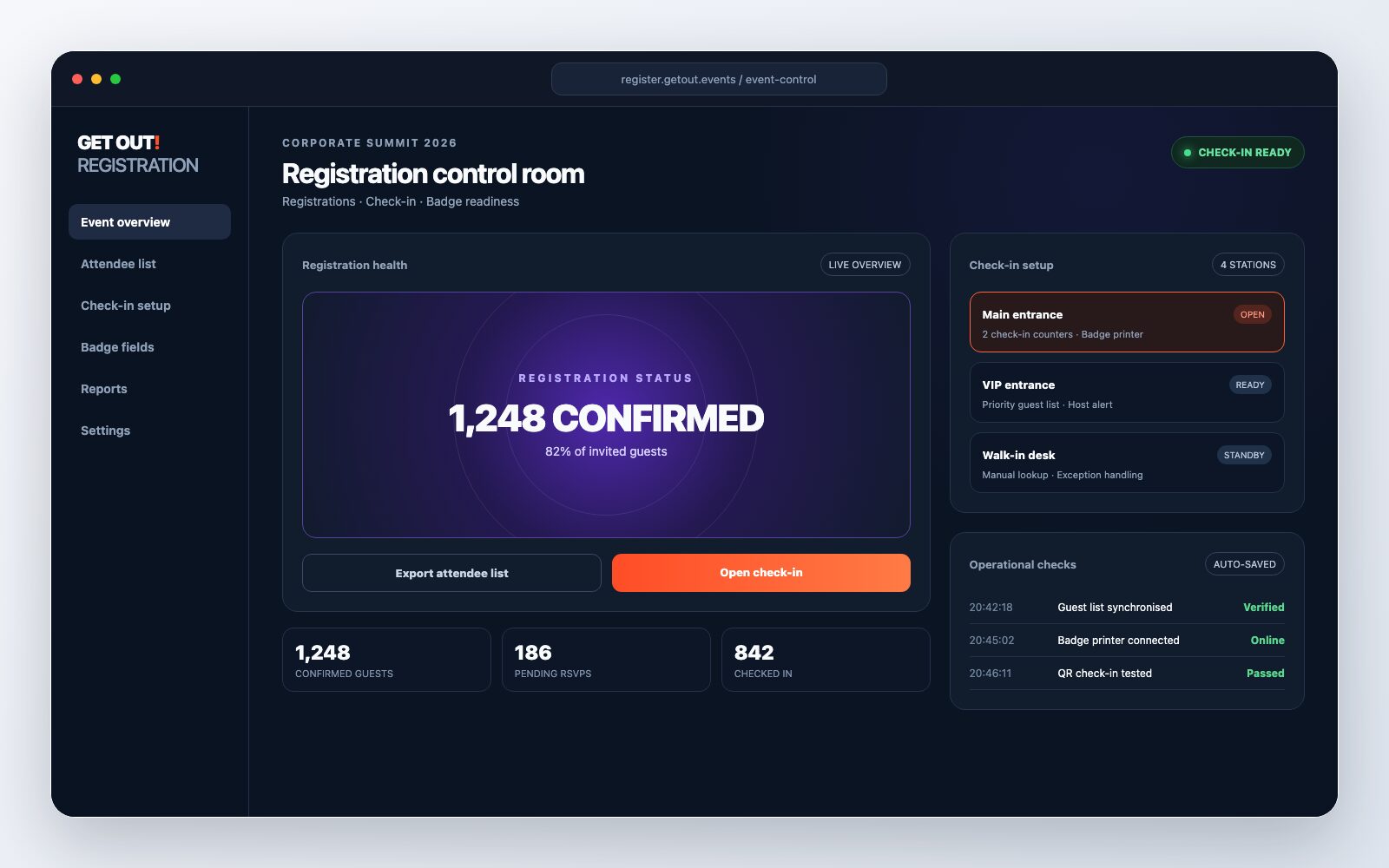
The accompanying interface image is a conceptual UI visual showing how attendee status, check-in readiness and operational exceptions could be reviewed. It is not a screenshot of proprietary Get Out! software. Final tools and configuration depend on the event brief.
Conference registration requirements checklist
- Journey: invitation, registration, approval, confirmation, reminders, arrival and departure stages are mapped.
- Categories: every guest type has documented access, badge and service rules.
- Data: required fields, unique identifiers, update ownership and authoritative sources are defined.
- Check-in: QR, name lookup, duplicate arrival and unknown guest responses are specified.
- Badges: content, production method, corrections, reprints and access indicators are agreed.
- Permissions: administrative, approval, reporting and operator access is separated appropriately.
- Integrations: field mappings, timing, duplicate handling and failed-transfer ownership are documented.
- Reporting: live and final outputs are tied to named operational decisions.
- Venue: connectivity, power, layout, queue routing and fallback procedures are verified on site.
- Support: configuration, rehearsal, event-day escalation and post-event handover have named owners.
Compare proposals on the complete delivery model
Request that each bidder respond to the same scenarios, assumptions and responsibilities. Compare not only functions and price, but also configuration effort, user access, support coverage, fallback practicality, data handover and unresolved dependencies. Where wider production, guest experience and venue coordination are involved, Get Out!’s event management services in Singapore provide relevant planning context.
A strong requirements document makes the eventual system easier to operate. More importantly, it gives the conference team a shared definition of readiness before the first guest reaches the registration desk.