Conferences vs Seminars vs Workshops: Understanding Corporate Event Formats
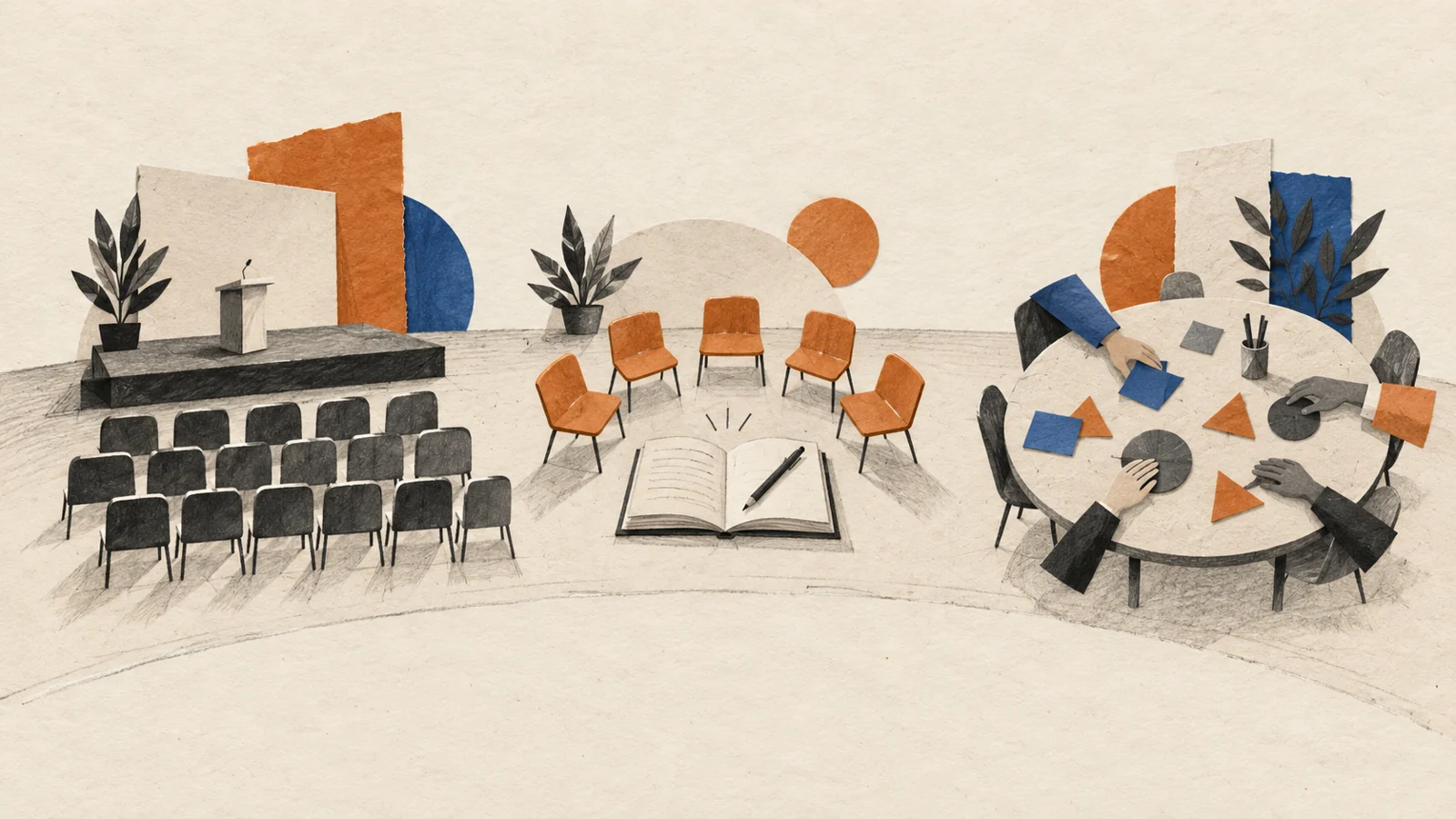
Corporate learning and knowledge-sharing events take many forms, and the distinctions between them matter — not only for planning purposes, but because different formats serve fundamentally different educational and professional development functions. The terms “conference”, “seminar”, “workshop”, and “symposium” are frequently used imprecisely in corporate contexts, leading to mismatched attendee expectations, inappropriate venue choices, and poorly designed programmes. This guide provides clear definitions of each format, examines the engagement models they employ, and explains the social and entertainment elements that distinguish them.
Conferences
A conference is a large-format gathering of professionals who share a common field, industry, or area of interest. Conferences are characterised by their multi-session, multi-track structure: a single conference may run for one to several days and feature dozens of individual sessions happening concurrently in different rooms or spaces. Attendees typically choose which sessions to attend based on their particular interests or specialisations.
The Events Industry Council’s industry glossary describes a conference as a participatory meeting for discussion, fact-finding, problem solving and consultation. This definition highlights a key characteristic: unlike a lecture or presentation, a well-designed conference creates conditions for active participation, dialogue, and exchange — not merely passive reception of content.
Typical structural elements of a conference include:
- Keynote sessions — High-profile speakers addressing the full attendee body on themes central to the conference’s purpose; these typically open and close the event
- Breakout sessions or concurrent tracks — Smaller sessions running in parallel, allowing attendees to self-select content relevant to their roles or interests
- Panel discussions — Moderated conversations between multiple speakers, often inviting audience questions
- Exhibition and expo floors — Spaces where sponsors, vendors, and partner organisations showcase products and services
- Poster sessions — Common in academic and research-adjacent conferences; presenters display work visually for attendee review and discussion
- Pre-conference workshops — Intensive skill-building sessions often offered as optional add-ons before the main programme begins
Conferences can be organised by professional associations, industry bodies, government agencies, or private companies. In Singapore, the Singapore Tourism Board (STB) and Singapore Exhibition and Convention Bureau (SECB) publish annual data on international conferences held in Singapore. In its May 2026 update, STB reported that Singapore retained ICCA’s top Meeting City in Asia Pacific position, with 156 meetings in 2025.
Entertainment and Social Elements at Conferences
Conferences are not purely didactic events; the social and networking dimensions are equally important for many delegates. Standard conference social programming includes:
- Kick-off brunches or welcome receptions — Held on the evening before or the morning of the first full day, allowing delegates to orient themselves and begin networking before the formal programme begins
- Hosted networking lunches — Structured or unstructured meal breaks that serve as the primary informal networking opportunity during conference days
- Gala dinners or awards nights — Formal evening events, often held on the final night of the conference, that combine recognition, celebration, and extended networking
- Mixers and cocktail receptions — Informal evening social functions, less formal than a gala dinner, providing a relaxed setting for relationship development
- Industry guest speakers — Prominent external voices who bring prestige, fresh perspectives, or entertainment value to the programme, often featured at opening or closing sessions
- Post-conference social events — Organised excursions, dinners, or entertainment evenings that allow delegates to extend their engagement into a leisure context
Plan networking time around the people attendees need to meet: allow unhurried breaks, provide clear meeting points and offer optional introductions rather than relying only on a large reception. Meeting Professionals International (MPI) publishes Meetings Outlook for industry business, budget and attendance trends; those forecasts should not be treated as proof that one event format creates stronger relationships.
Seminars
A seminar is a smaller, more focused educational gathering in which participants engage with a specific subject in depth. The term derives from the Latin seminarium (a seed plot), reflecting its origin in the university tradition of graduate-level discussion groups convened around a focused topic.
In corporate contexts, a seminar typically involves:
- A single room and a single programme stream (no concurrent sessions)
- A smaller group of attendees, typically between 20 and 150 people
- A combination of presentation and facilitated discussion
- One or a small number of expert presenters or facilitators
- A defined, focused topic or theme
Seminars are well-suited to continuing professional development (CPD), regulatory updates, technical knowledge transfer, and introductory learning on a new subject area. Unlike a conference, which aggregates a broad field of knowledge, a seminar goes deep on a narrow topic.
The distinction between a seminar and a lecture lies in interactivity. A lecture is primarily one-directional: an expert presents to a largely passive audience. A seminar, by contrast, incorporates structured opportunities for participant contribution — questions, discussion, case analysis, or group problem-solving. The facilitator’s role in a seminar is to guide and deepen collective inquiry, not merely to transmit information.
If attendees need continuing professional development (CPD) credit, confirm recognition, eligible learning hours and attendance evidence with the relevant professional body before advertising the seminar. Do not assume that the seminar format alone qualifies. Check that institutional references are current: the Singapore Accountancy Commission merged with ACRA on 1 April 2023, as recorded in ACRA’s official history.
Social Elements at Seminars
Seminars are generally shorter and less formal than conferences, so their social programming is more modest. Common elements include:
- Pre-seminar registration and coffee — An informal gathering period before the programme begins
- Lunch or refreshment breaks — Networking opportunities between sessions
- Networking reception — A post-seminar social period, often held over light refreshments
While a seminar’s social programming is less elaborate than a conference, the smaller group size can make networking more intensive: with fewer attendees, participants have a higher probability of engaging meaningfully with any given individual.
Workshops
A workshop is a practical, skills-focused gathering in which participants learn by doing rather than primarily by listening. The defining characteristic of a workshop is its emphasis on active participation and hands-on application: attendees are expected to produce something — a plan, a prototype, a solution, a skill — during the session itself.
Workshops are characterised by:
- High participant-to-facilitator interaction — The facilitator’s role shifts from presenter to coach and guide
- Individual or group exercises — Participants apply concepts in real time, often in small groups
- Tangible outputs — A well-designed workshop ends with each participant or group having produced something concrete
- Smaller group sizes — Workshop dynamics typically work best with groups of 10 to 40; beyond this, individual attention and active participation become difficult to maintain
- A skills development or problem-solving focus — Workshops address a defined competency gap or working challenge
Common workshop formats in corporate settings include design thinking workshops, strategic planning workshops, writing and communication skills training, data analysis technique sessions, and leadership development programmes. Professional facilitation organisations such as the International Association of Facilitators (IAF) maintain guidelines for workshop design, emphasising the importance of clear learning objectives, appropriate time allocation per exercise, and skilled facilitation that balances structure with flexibility.
Workshops are typically shorter than conferences and seminars — a half-day to two days is most common. Multi-day residential workshops, sometimes called “offsites” or “retreats”, combine intensive skills development with team cohesion objectives and may include elements that overlap with team building.
In Singapore, a workshop is not automatically eligible for SkillsFuture funding because it is delivered as in-house corporate training. Before budgeting for a subsidy, check the specific course and the employer and trainee eligibility requirements in the official training subsidies for employers guidance, and confirm the applicable support with the training provider.
Social Elements at Workshops
Because workshops tend to be smaller and more intensive, their social dimensions are less formally programmed. The interaction inherent in the workshop format itself — small group exercises, shared problem-solving, peer feedback — produces a degree of relationship development. However, multi-day workshops often include:
- Group dinners — Informal evening meals that allow participants to build relationships outside the structured learning environment
- Team activities — Shorter team-building exercises integrated within the workshop programme
Symposiums
A symposium sits between a conference and a seminar in format and scale. Originally denoting a learned discussion over a shared meal (from the Greek symposion, “drinking together”), the contemporary symposium typically brings together experts in a specific field for focused academic or technical exchange.
Key characteristics of a symposium include:
- A defined, narrow focus on a specific research question, technical problem, or professional issue
- Invited or curated participants, often with relevant expertise
- Presentation of original work, research, or analysis — followed by critical discussion
- A relatively smaller and more specialised attendee group than a general conference
In corporate contexts, the symposium format is most commonly used by research-intensive organisations, professional bodies publishing technical standards, and organisations convening expert advisory groups. The format prioritises depth of intellectual exchange over breadth of coverage.
Symposiums may include social elements — a formal dinner, a reception — but these are secondary to the substantive programme. The defining social dynamic of a symposium is peer-level expert exchange, which distinguishes it from the more hierarchical knowledge transfer typical of seminars.
Choosing the Right Format
The appropriate format depends on the primary objectives of the gathering:
| Objective | Recommended Format |
|---|---|
| Broad knowledge sharing across a field | Conference |
| Deep expertise transfer on a specific topic | Seminar |
| Skill development and practical application | Workshop |
| Expert exchange and original research discussion | Symposium |
| Team cohesion and interpersonal development | team building event |
| Milestone recognition and professional networking | Gala dinner / awards event |
In practice, many corporate events blend formats: a two-day sales conference might include keynote sessions (conference format), skill-building breakouts (workshop format), and an awards dinner (gala format). Understanding the distinct purposes of each format enables more intentional programme design — and clearer communication with attendees about what to expect.
Singapore as a MICE Hub
Singapore’s development as a MICE destination has been supported by sustained public investment in world-class infrastructure, including the Sands Expo and Convention Centre, Marina Bay Sands’ convention facilities, the Singapore EXPO, and Resorts World Convention Centre. The Singapore Tourism Board’s MICE incentive programmes have supported the city-state in attracting both international association conferences and corporate events from regional and global organisations.
Singapore recorded 1.1 million MICE visitor arrivals in 2024, compared with 830,000 in 2023, according to the Ministry of Trade and Industry’s November 2025 parliamentary reply. The depth of Singapore’s professional event management infrastructure — including a well-developed supply chain of AV specialists, professional facilitators, catering operators, and technology providers — enables the delivery of events across all formats to international standards.
For organisations planning corporate learning events in Singapore, the range of available venues, formats, and professional support ensures that the right configuration can be matched to almost any learning or professional development objective.
References
- Events Industry Council. Conference, Industry glossary.
- Meeting Professionals International (MPI). Meetings Outlook.
- Singapore Tourism Board. (2026). Singapore Raises the Bar for Global Business Events.
- Ministry of Trade and Industry. (2025). Written reply on MICE visitor arrivals.
- International Association of Facilitators (IAF). (2022). Facilitation Core Competencies. IAF.
- SkillsFuture for Business, GoBusiness. Training subsidies for employers.
- Accounting and Corporate Regulatory Authority (ACRA). Overview of ACRA.
Choose the workshop format by the behaviour you need
Corporate workshops work best when the organiser defines one observable outcome before choosing activities. For relationship-building and morale with practical reflection, a team bonding workshop can combine inclusive challenges with a short debrief. When the team must practise collaboration, communication and decision-making, choose facilitated team building and allocate enough time for guided reflection.
If the outcome is speaking up, constructive disagreement or learning from mistakes, a focused psychological safety workshop in Singapore is more precise than a generic seminar. The event brief should state the audience, recent team context, available time and the behaviour leaders want to see after the session.