
A digital queue management system can make arrivals more orderly, but the interface is only one part of the operating model. Singapore organisations evaluating a customised QMS should first define who is arriving, which services they need, how priority is handled and what operators must do when conditions change.
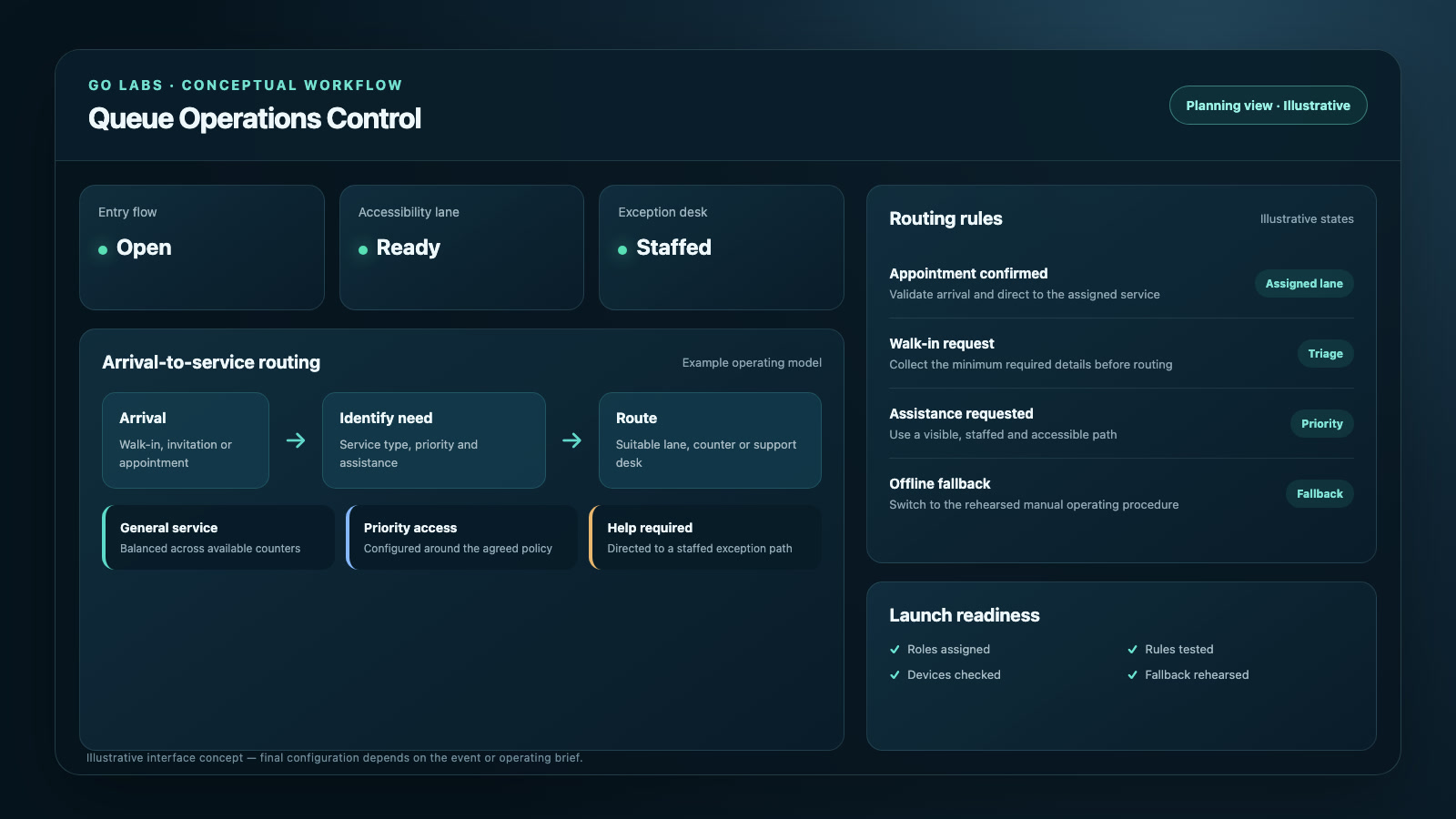
Get Out!’s GO Labs team can scope and deliver a customised QMS for an event or operating environment. This is not presented as an off-the-shelf proprietary Get Out! product. The selected tools, configuration, integrations and service arrangements would depend on the agreed brief.
Choose the right queue model
Physical line control
A physical queue keeps people visibly ordered through barriers, floor markings, hosts and service counters. It can be straightforward for short, predictable transactions, but it requires sufficient space and active supervision. Operators need a plan for merging lines, reopening counters and assisting people who cannot stand for extended periods.
Virtual queueing
A virtual queue issues a ticket or digital position so visitors can wait away from the service point. Depending on the scope, updates might be shown on displays or sent through an agreed notification channel. The design must account for visitors without compatible devices, missed notifications, late returns and people who need staff assistance.
Appointment-led flows
Appointment-led operations allocate expected arrival windows in advance. They can help distribute demand, but appointments do not eliminate queues. Early arrivals, late arrivals, walk-ins and transactions that exceed their expected duration still require operating rules. Some environments benefit from a hybrid model combining appointments with a managed walk-in queue.
Discovery inputs for a customised QMS
Discovery should document the complete service journey rather than starting with screen layouts. Useful inputs include forecast arrival volumes, peak periods, venue layout, service duration ranges, counter capacity, visitor profiles, accessibility needs, languages, staffing levels and escalation paths.
Teams should also identify each queue type. Examples include general enquiries, credential collection, payment, document verification, technical support and priority assistance. Every queue needs clear entry conditions, service rules, ownership and an exit state. Related planning may also draw on conference registration system requirements when registration and queue operations overlap.
Map arrival, ticketing and routing
Ticket issuance may begin at a staffed point, kiosk, web page or pre-arrival link, depending on the agreed design. The process should make the next step understandable without exposing unnecessary personal information. Where identification is required, teams can compare methods such as QR code check-in and name lookup.
Routing rules determine which counter receives each visitor. They may consider service type, counter capability, appointment status, priority class and current availability. Rules should remain understandable to operators. A theoretically efficient routing engine is of little value if supervisors cannot explain, override or recover it during live operations.
Accessible and manageable requirements
| Area | Requirement to define | Operational question |
|---|---|---|
| Access | Assisted, seated and priority waiting paths | How can staff help without forcing disclosure? |
| Notifications | Visual, audible, device-based or staff-led cues | What happens when a visitor misses a call? |
| Operators | Host, counter, supervisor and administrator permissions | Who may reroute, pause or close a queue? |
| Resilience | Offline, paper and manual reconciliation procedures | How will service continue during disruption? |
| Data | Minimum fields, access, retention and deletion approach | Which information is genuinely necessary? |
Accessibility should be designed into the operating flow, not treated as an exception. Priority handling may include mobility needs, sensory needs, caregivers or other approved categories. The organisation should define fair rules, discreet assistance methods and staff guidance appropriate to its environment.
Notifications, roles and supervision
Notifications should state what the visitor needs to do next. Their delivery and timing will depend on the selected channels and venue conditions. Alternatives are important where visitors lack mobile access, decline notifications or cannot perceive a particular cue.
Operator roles should follow actual responsibilities. Hosts may issue tickets, counter staff may call the next suitable visitor, and supervisors may change capacity or resolve exceptions. Administrative access should be limited according to the agreed design. Training should cover normal work, overrides, abandoned tickets, duplicate records and escalation.
Integrations, reporting and privacy
A QMS might need to exchange information with registration, appointment, CRM, identity or reporting tools. Each proposed integration should be checked for available interfaces, field ownership, update timing, failure behaviour and reconciliation. Integration feasibility should not be assumed until the relevant systems and vendors have been reviewed.
Reporting can be scoped around operational questions such as arrival distribution, queue abandonment, service duration and counter utilisation. Definitions matter: a “wait time” needs agreed start and end events before it can be interpreted consistently. Reports should support operational review without collecting unnecessary visitor data.
Privacy planning should apply data minimisation, role-based access, appropriate retention choices and clear ownership, subject to the organisation’s policies, selected tools and applicable requirements. This guide is operational guidance, not legal advice. Specialist review may be appropriate where sensitive information or regulated processes are involved.
Connectivity and fallback
Venue connectivity should be assessed where the system will actually operate, including counters, kiosks and temporary work areas. The design may require suitable local networking, power, device management and technical support, depending on scope.
Manual fallback is essential even where connectivity appears strong. Prepare a controlled method to issue positions, call visitors, record completed service and reconcile activity later. Staff should know who can activate fallback and how visitors will be informed. Related station planning is covered in this guide to event registration stations in Singapore.
Phased implementation checklist
- Discover: document visitors, services, demand, venue constraints, accessibility needs and ownership.
- Design: map queue types, ticket rules, routing, notifications, exceptions, permissions and data fields.
- Validate: confirm tool suitability, integration feasibility, infrastructure and fallback procedures.
- Configure: prepare workflows, operator views, reporting definitions and approved content.
- Test: rehearse peak arrivals, priority cases, missed calls, device failure, connectivity loss and recovery.
- Launch: brief operators, assign escalation owners, monitor live conditions and control changes.
- Review: reconcile records, assess agreed measures and capture improvements for the next operating cycle.
Questions for procurement
- Is the proposal a configured existing tool, a custom build or a combination?
- Which requirements, integrations, devices and third-party charges are included?
- Who owns configuration, data handling, operator training and live support?
- What assumptions affect performance, availability and notification delivery?
- How will testing, acceptance, changes, fallback and post-launch support be managed?
The interface image on this page is a page-specific conceptual workflow showing possible arrival routing, priority access and fallback readiness. It is not a screenshot of proprietary Get Out! software.
For programmes where queueing forms part of a wider guest journey, Get Out! can also support event registration services and broader event management in Singapore. Scope, responsibilities and tools should be confirmed before implementation.