Event Contingency Plan for Singapore: What to Do When Something Goes Wrong
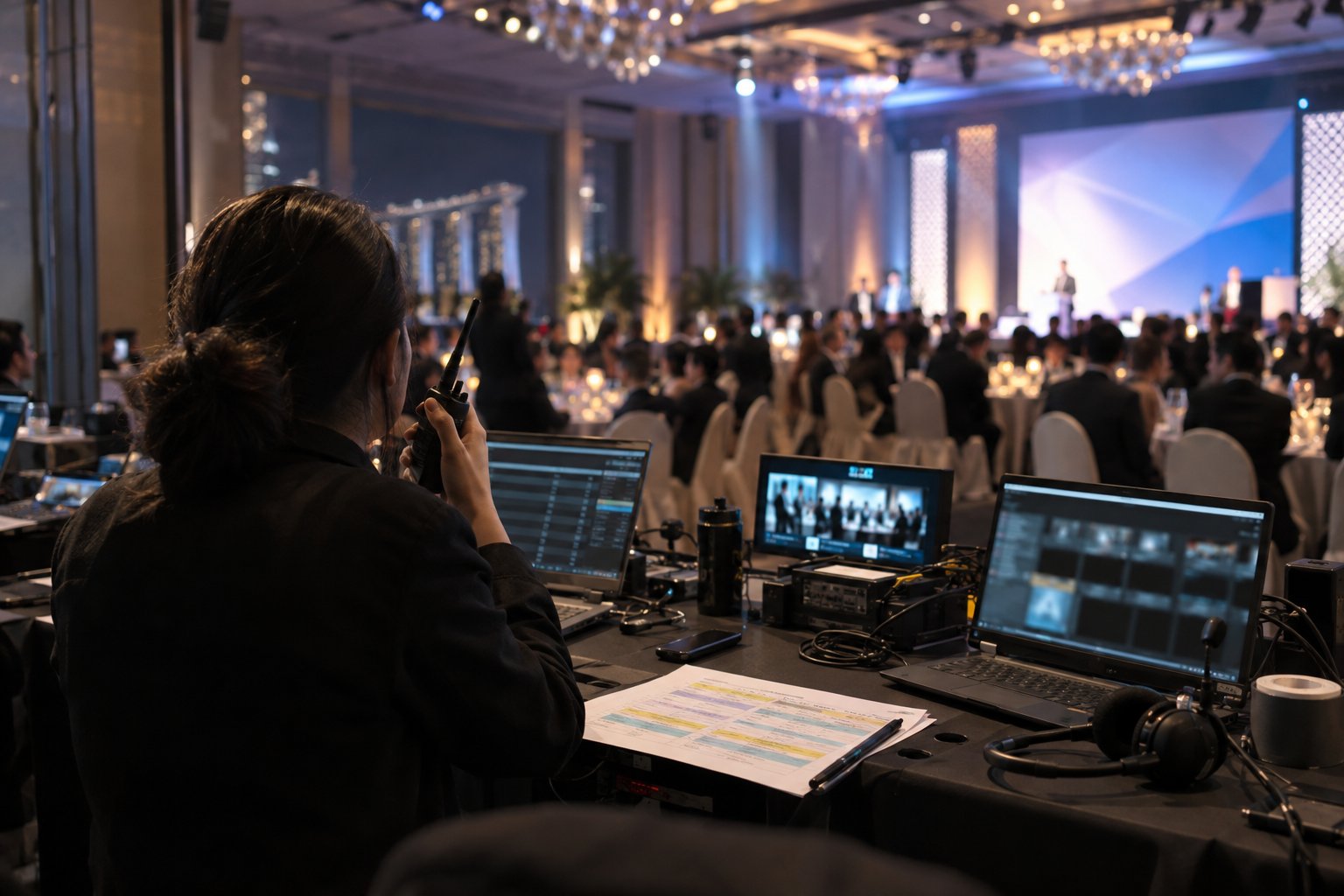
Something will go wrong at your event. A speaker gets stuck on the PIE, a wireless microphone drops out, the buffet runs fifteen minutes late, or a thunderstorm rolls in over the field an hour before the family day starts. An event contingency plan does not stop these things from happening. It decides, in advance, who fixes each one, what the backup is, and how long the team waits before switching to it.
This guide is for HR, admin and corporate communications teams in Singapore who are running a dinner and dance, conference, townhall, family day or launch.
What an event contingency plan is (and what it is not)
A contingency plan is a short, practical document that answers three questions for each likely problem: what is the trigger, who owns the response, and what is the backup.
It is different from a risk assessment. A corporate event risk assessment identifies hazards before the event and rates how likely and how serious they are. The contingency plan picks up where that leaves off: it is the on-the-day response once a risk actually turns into a problem. You need both, and the contingency plan should be built from the risks you already listed.
It is also different from the run sheet. The run sheet describes the event when everything goes to plan. The contingency plan describes what changes in the run sheet when it does not. Keep the two side by side.
Recoverable problems vs visible failures
The most useful way to think about what to do when something goes wrong at an event is to sort every problem into one of two groups.
- Recoverable problems are fixed before guests notice. A cable is swapped during a video, a late table of guests is seated during the welcome drink, a replacement microphone is handed over between speakers.
- Visible failures are the ones guests see: dead air on stage, a long queue at registration, an empty buffet line, a programme segment that is cut without explanation.
The goal of a contingency plan is to keep as many problems as possible in the first group. That comes down to two things: buffers (time, spare equipment, spare people) and clear decision owners who can act without waiting for a meeting.
Common event failure scenarios in Singapore
Rain and lightning at outdoor events
Singapore weather can change within the hour, and afternoon thunderstorms are common for much of the year. For any outdoor family day, carnival or poolside dinner, the wet weather plan should be decided at booking stage, not on the morning itself. Confirm the fallback space and how long the move takes. Agree a decision time, for example three hours before guest arrival, and check the NEA weather forecast and lightning alerts against it. Outdoor activity should pause when lightning risk is reported nearby, even before it rains. If you are weighing an outdoor format, our outdoor dinner and dance venue guide covers what to look for in a rain fallback.
AV failure
Microphones, playback laptops, clickers and screen feeds are the most common source of visible failures. Ask for a spare handheld and a spare lapel on stage, a second playback laptop running the same files in sync, and every presentation loaded and tested during rehearsal. The AV lead should own the fix. The stage manager or emcee should own the cover: a line ready to fill thirty seconds while the swap happens.
Power trips
Large LED walls, sound systems, coffee machines and catering warmers on the same circuit can trip the supply, especially in function rooms and outdoor sites with temporary power. Confirm the power load with the venue during the site visit, ask where the distribution board is and who from the venue can reset it, and keep essential items such as the emcee microphone and stage lighting on a separate circuit where possible.
Late speaker or emcee
Keep a call time for the emcee and every speaker that is well ahead of their slot, and name one person to track arrivals. If a speaker is late, the backup is usually to swap two segments in the programme. Agree in advance which segments can move. If the emcee is delayed, a nominated internal host or the stage manager should have the opening script and be ready to read it.
Headcount swings
Attendance can drop on a rainy weekday evening or jump when a department decides to bring its whole team. Agree the final guaranteed number and the caterer’s cut-off date in writing, find out how many extra guests the kitchen can serve on the night, and set aside a few extra seats and place settings.
F&B delays
Kitchens run late, buffet lines run slow, and courses get held because a speech overran. Agree with the banquet captain on the exact cue for each course and a single point of contact who can tell you how far behind the kitchen is. If food is late, the backup is to pull forward a programme item such as a game, a video or a lucky draw round so the room is not waiting in silence.
Medical incident
Know where the nearest AED and first aid kit are, who on the team has first aid training, and which hospital is closest. Collect dietary and allergy information at registration and pass it to the caterer. For larger or more active events, consider booking a first aider or medic on site. In an emergency, call 995 for SCDF and send one person to meet the ambulance at the entrance.
Crowd and queues
Registration, photo booths, buffet lines and the car park exit at the end of the night are the usual pinch points. Open more registration counters than you think you need for the first thirty minutes, set up queue lines with clear signage, and assign a crew member to each pinch point during peak times.
Haze and heat
Haze episodes and hot afternoons affect outdoor events and anyone with breathing conditions. Check the NEA PSI readings and heat stress advisories in the days before, decide in advance what readings would move you indoors or shorten outdoor segments, and plan shade, water stations and rest areas. The family day safety checklist has more on outdoor preparation.
Transport problems
Chartered coaches can arrive late, take a wrong turn or be stuck at a venue drop-off point. Get the coach operator’s on-the-day contact number, share the exact pick-up point with a map pin, and have a crew member at each pick-up with the passenger list.
Scenario, owner and backup table
Use this table as a starting point and adjust it to your event. The point is that every row has one named owner, not a department.
| Scenario | Trigger | Owner | Backup |
|---|---|---|---|
| Rain or lightning (outdoor) | Forecast or alert at decision time | Event producer | Move to covered or indoor fallback; adjust programme |
| Microphone or playback failure | No sound or no video on cue | AV lead | Spare mic, second laptop; emcee fills time |
| Power trip | Loss of power to stage or screens | AV lead with venue technician | Reset at board; essential items on separate circuit |
| Late speaker | Not arrived by call time | Speaker coordinator | Swap segments; brief emcee on new order |
| Late or absent emcee | Not arrived by call time | Stage manager | Internal host reads opening script |
| Headcount above guarantee | Walk-ins exceed spare seats | Registration lead | Extra settings; inform banquet captain |
| F&B delay | Course not ready on cue | Client liaison with banquet captain | Pull forward game, video or lucky draw |
| Medical incident | Guest unwell or injured | First aider on team | AED and first aid kit; call 995 if needed |
| Long queues | Queue beyond set marker | Floor lead | Open extra counter; redeploy crew |
| Haze or heat | PSI or heat advisory above agreed level | Event producer | Shorten or move outdoor segments; water and shade |
| Transport delay | Coach not at pick-up on time | Transport coordinator | Call operator; arrange taxis; adjust start |
Decision rules and escalation
Slow decisions do more damage than the original problem. Agree these rules before the event.
- One decision owner. Name one person, usually the event producer, who makes the call on anything that changes the programme. Everyone else fixes problems inside their own area and reports up.
- Fix first, report second. Crew leads are expected to solve problems within their area straight away, then inform the producer.
- Set time limits. Agree how long a problem can run before the backup is used, for example two minutes for an AV issue on stage before moving to the next segment.
- Escalate to the client only for decisions that need them. Cutting a speech, changing the venue or calling off an outdoor segment should go to one named client decision maker, with the producer presenting the options and a recommendation.
- Safety overrides the programme. Anyone on the team can stop an activity if they believe someone is at risk.
Keep a few minutes of slack between major segments so the team can recover without the audience seeing a gap.
Briefing the team
A plan nobody has read is not a plan. Hold a short briefing with the full crew, the venue contact, the AV team and the emcee before doors open. Cover:
- who the decision owner is and how to reach them
- radio channels or the group chat used on the day, and the code words for medical and safety issues
- the top five scenarios most likely for this event and what each person does
- locations of the first aid kit, AED, fire exits, distribution board and fallback space
- the decision times, such as the wet weather call
Give each crew lead a one-page version of the contingency table relevant to their area, printed and on their phone. During rehearsal, walk through at least one scenario, such as a dead microphone mid-speech, so the emcee and AV lead have practised the handover.
Budget contingency
Some backups cost money: a rain tentage, a second playback laptop, a standby generator, a medic, extra coach capacity. Decide which ones are worth paying for up front based on your risk assessment, and set aside a separate contingency line in the budget for the unexpected. Many teams hold back a small percentage of the total event budget for this. Agree in writing who can approve spending from that line on the day and up to what amount, so the producer does not have to chase approval while guests wait. Our corporate event budget calculator can help you plan that line alongside your other costs.
Post-event review
Within a week of the event, gather the producer, crew leads and client team for a short review. For each problem that came up, record what happened, how long it took to fix, whether guests noticed, and what should change next time. Note the near misses too, as they show where the plan is thin.
Update your contingency template with what you learned and attach the review to your corporate event report.
Event Contingency Plan FAQ
What should an event contingency plan include?
It should list the likely problems for your event, the trigger for each, one named owner, the backup action and any time limit before the backup is used. Add the decision owner, escalation path, emergency contacts and budget approval limit.
What is the difference between a risk assessment and a contingency plan?
A risk assessment identifies and rates hazards before the event. A contingency plan sets out what the team does on the day when one of those risks becomes a real problem. The contingency plan should be built from the risk assessment.
What should I do when something goes wrong at an event?
Let the owner of that area fix it straight away, keep the audience engaged while it is fixed, and inform the decision owner. If the fix takes longer than the agreed time limit, switch to the backup. Only escalate to the client when the programme or safety is affected.
When should we make the wet weather call for an outdoor event in Singapore?
Agree a fixed decision time in advance, often a few hours before guest arrival, so there is enough time to move into the fallback space. Check the NEA forecast and lightning alerts against it. Lightning risk should pause outdoor activity even if it is not raining yet.
How much budget should we set aside for contingency?
There is no fixed rule. Pay up front for backups that your risk assessment shows are likely to be needed, such as rain cover for an outdoor event, then hold a separate contingency line for the unexpected with a clear approval limit for the day.
Who should be the decision owner on the day?
Usually the event producer or lead organiser, because they can see the whole event and talk to every crew lead. The client should name one person they can escalate to for decisions that change the programme, the venue or the budget.
Plan your next event with Get Out! Events
Get Out! Events plans and runs corporate events across Singapore, from dinner and dances and conferences to family days and launches. Every event we run comes with a run sheet, a contingency plan with named owners, and a producer on the ground who makes the call when something changes. Find out more about our event management services in Singapore and tell us about your event.