Team Building for Large Groups in Singapore: The HR Manager's Planning Guide (100–500 Pax)
Managing team building for 50 people is already stressful. Scale that to 200, 300, or 500 — and suddenly you’re coordinating halal meal counts, negotiating with venues that keep moving their minimum spend, managing RSVPs from managers who think optional means optional, and trying to find activities that don’t alienate the 55-year-old finance director and the 24-year-old grad hire.
This is the guide that exists because most team building content is written for groups of 30. If you’re an HR Manager or People Lead dealing with a large group event in Singapore, here’s everything you need to know before you start calling vendors.
Why Large Groups Are Different (Not Just “More of the Same”)
The jump from 50 to 200 pax isn’t linear. It introduces three problems that smaller events don’t face:
Logistics complexity: Check-in, food service, transport, briefing and activity transitions share the same arrival windows. Rehearse the slowest step with the actual equipment and staff before setting the timetable; do not assume that a small-group run time carries over unchanged.
Engagement at scale: In a 30-person event, a disengaged participant can be pulled in by a facilitator. In a 300-person event, you can have an entire sub-group checking phones during the activity — and no one notices until the energy drops.
Delivery capability: Ask who manages each zone, who controls the overall timetable and how instructions reach every team. Confirm relevant delivery experience, staffing, communication and the written scope rather than relying on a vendor’s advertised maximum headcount.
The good news: with the right format and the right vendor, large group team building can actually be more energetic and more memorable than small-group events. The scale creates spectacle. The question is how to harness it.
Formats That Work at Scale (100–500 Pax)
Not every activity scales gracefully. Here’s an honest breakdown:
Amazing Race Singapore (100–400 pax) ✅ Best for outdoor events
Singapore’s urban landscape is tailor-made for Amazing Race formats. Teams of 8–12 complete checkpoints across a defined zone — Marina Bay, Sentosa, Gardens by the Bay, or a customised city route. Simultaneous parallel running means all 300 people are active at the same time, with a central debrief at the end.
What makes it work at scale: define team assignments, checkpoint capacity, release times and communication before the start. Confirm route permissions, accessibility and the number of teams that can safely use each checkpoint. Parallel running is a design option, not proof that every location supports the same headcount.
Approximate cost: $55–$90 per pax for a half-day outdoor Amazing Race.
Sports Day / Mini Olympics (100–500 pax) ✅ Best for outdoor + family day combos
Multiple sporting stations can support rotations when the venue layout, equipment and supervision fit the group. Give each station a tested operating limit and keep waiting teams outside the active area. Confirm suitability for the participants rather than assuming that one format scales automatically.
Key logistics note: you need a large outdoor space with shade and shelter options. Bishan Park, East Coast Park (with permit), or dedicated facilities like Singapore Sports Hub work well. Decide in advance whether to purchase an optional wet-weather programme and backup venue.
Approximate cost: $45–$75 per pax depending on equipment and facilitation level.
Mega Trivia / Game Show (100–300 pax) ✅ Best for indoor events
A professional MC-hosted trivia show with team competition works surprisingly well at scale — if the production quality is right. Think projector screens, wireless buzzers, team score tracking, and a host who knows how to play a room of 250 people.
Consider seated game-show formats where age, mobility or physical confidence vary. Review question design, audibility, sightlines and accessible participation with the organiser; no activity is automatically inclusive for everyone.
Approximate cost: $50–$85 per pax including AV, MC, and facilitation.
Drumming Circles / Mass Participation Art (50–500 pax) ✅ Best for high-energy launch moments
Drumming programmes, mass mosaic building and collaborative art can offer shared participation. Confirm equipment quantities, hearing considerations, facilitation, setup and the room layout for the actual group before selecting a format.
Best used as part of a broader programme — typically as an opening or closing activity rather than the main event.
Approximate cost: $40–$70 per pax for a standalone 60–90 minute session.
Cooking Challenges (Works up to ~120 pax) ⚠️ Check before scaling
Cooking team building depends on workstations, appliances, food handling and supervision. Ask the venue for the operating capacity of the proposed activity, not just its seated event capacity. Rotating smaller groups may be more workable than simultaneous cooking.
If you love this format for a 200-pax event, ask vendors about “cooking carnival” formats where teams rotate through culinary stations rather than all cooking simultaneously.
Best Venues for Large Group Team Building in Singapore
Indoor Venues (for 100–500 pax)
Suntec Singapore Convention & Exhibition Centre — One of the most flexible large-group venues in the city. Multiple hall configurations, excellent AV infrastructure, central location. Good for trivia/game show formats and structured indoor activities.
Marina Bay Sands Expo & Convention Centre: Assess the proposed room, technical specification, access arrangements and quotation with the venue. Confirm AV and production inclusions rather than assuming equipment comes with the space.
Singapore EXPO: Review the current event spaces, layout and technical requirements with the venue. Attendance limits depend on the booked space and approved configuration. The official venue site is a starting point, not confirmation of availability or a team-building booking.
Hotel ballrooms: Ask for the floor plan and permitted activity layout, including stage, tables, circulation and emergency access. A seated banquet capacity does not establish the operating capacity for active team building.
Outdoor Venues (for 100–500 pax)
Sentosa: Confirm which specific location can be booked for the proposed activity, its permitted use, site access and operating conditions. Public access to a beach or attraction does not establish permission for an organised corporate event.
Bishan-Ang Mo Kio Park: Use the NParks venue-booking information to check the location and application requirements, then confirm the actual activity layout and permissions.
East Coast Park: Check the current NParks park information and the requirements for the exact event space. Confirm approved use, access, power, washrooms and crowd circulation before treating a location as bookable.
Venue shortlist check: Remove any location from the working shortlist until current event-booking access is confirmed directly. A historic venue description or large outdoor footprint is not evidence of present availability.
Cost Breakdown: What You’ll Pay for Large Group Team Building
Illustrative planning estimates, not Get Out! package prices. The existing figures below are examples in SGD, not validated current market rates, an offer or a quotation. Do not use them to assume inclusions or commit a budget. Obtain an itemised quotation for your dates, headcount, venue and confirmed scope.
| Activity Format | 100 pax | 200 pax | 400 pax |
|---|---|---|---|
| Amazing Race (outdoor) | $75–$90 | $60–$80 | $55–$70 |
| Sports Day / Olympics | $65–$80 | $55–$70 | $45–$60 |
| Mega Trivia / Game Show | $75–$90 | $65–$80 | $55–$70 |
| Drumming Circle | $60–$75 | $50–$65 | $40–$55 |
| Full-day programme (AM + PM activities + F&B) | $120–$180 | $100–$150 | $85–$130 |
What drives cost up: Premium venues, F&B inclusion, custom branding, photography/videography, specialised equipment.
What drives cost down: Public parks (venue cost minimal), morning-only programmes, existing client relationships with vendors.
For a 200-pax half-day programme with basic F&B, budget $12,000–$18,000 all-in. For a full-day event at a hotel venue with meals, expect $25,000–$45,000.
Logistics You Need to Plan For (The Checklist HR Managers Miss)
These are the details that cause problems on the day for large group events:
Dietary requirements: Collect actual requirements through the RSVP process rather than estimating halal, vegetarian or allergy counts from demographics. Confirm catering certification where required, meal labelling, dietary handling and how sensitive information is shared with the responsible caterer.
Registration and check-in: Test the chosen registration method with the planned arrival pattern. Decide queue space, lane responsibilities, exception handling and a separate late-arrival route. Match staffing and equipment to observed processing time rather than copying a fixed station count.
Briefing logistics: With 300 people, you can’t give a single briefing and expect everyone to hear it. Plan for team captains who receive a separate facilitator briefing 30 minutes before the event, then cascade instructions to their teams. Good vendors build this into their programme design.
Wet-weather decision: For outdoor events in Singapore, decide whether to add a separately quoted alternative programme and indoor or sheltered venue. Confirm the scope, charges, capacity and availability in writing; these items are not included by default.
Transport: For events outside of MRT range (Sentosa is fine, but East Coast Park is less so), consider chartered buses. For 200 pax, 4–5 standard coaches. Factor this cost into your budget from day one.
Photography: You’ll want it. A professional photographer for a 200-pax event typically runs $600–$1,200 for a half-day. Build it in — these photos end up in internal comms, LinkedIn posts, and next year’s budget justification.
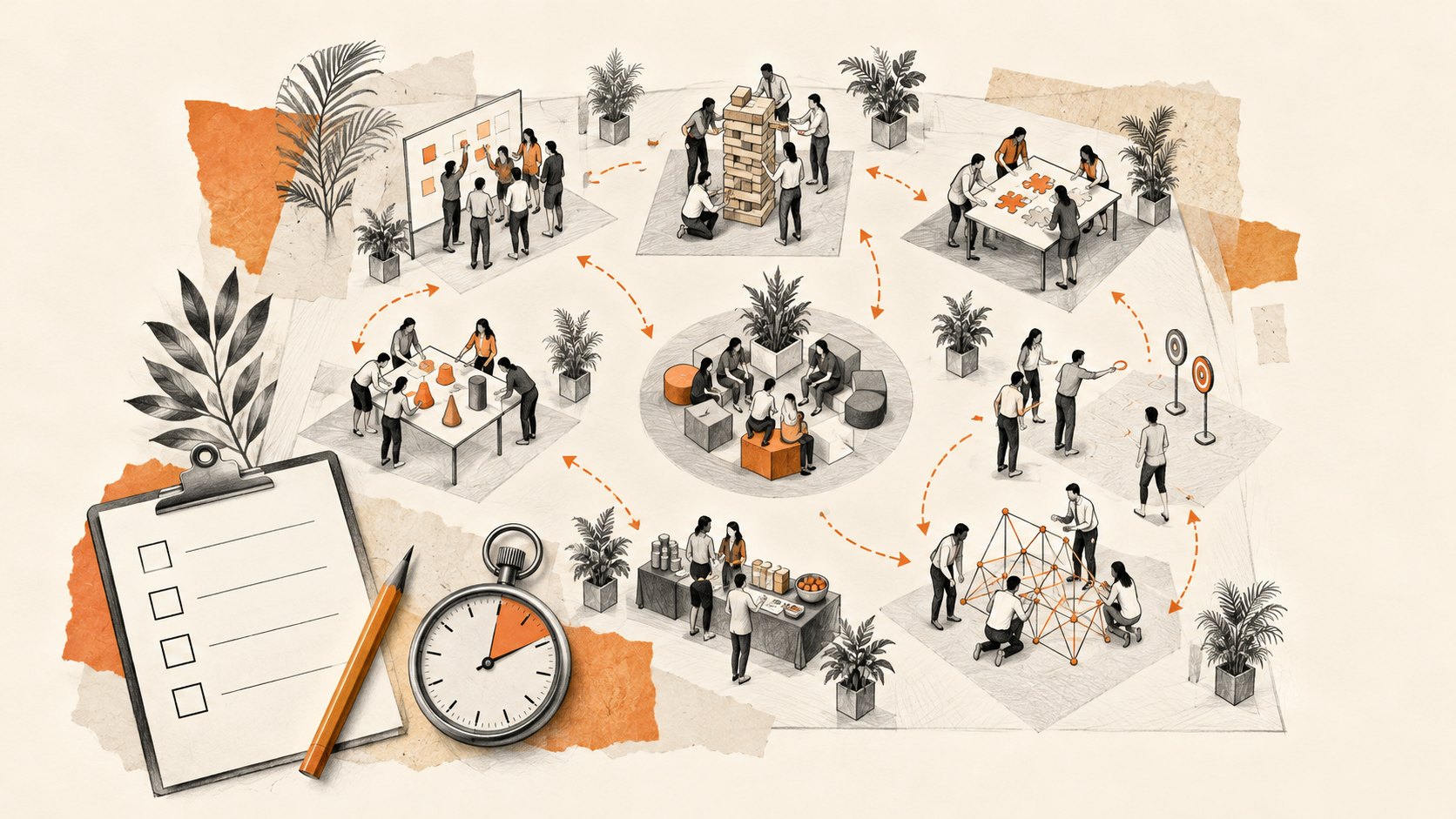
Station-flow checklist: test the bottleneck before confirming the run sheet
Use this planning aid with the venue and delivery team. It is a working checklist, not a certified crowd-capacity calculation or a record of a past client event. A venue’s attendance limit and a station’s practical throughput answer different questions.
- Record the operating limit. For every station, note the number of people who can participate safely at once, equipment available, facilitator responsibility and any accessibility adjustments. Obtain the venue’s requirements separately.
- Time a complete trial. Measure arrival, explanation, activity, scoring, reset and release with the actual props. Do not time only the entertaining part. Record the slowest realistic cycle and allow an agreed buffer.
- Map the waiting area. Mark where the next team stands without blocking the activity, walkways or emergency access. Identify the overflow point and the person authorised to pause a release.
- Separate competing flows. Walk the routes for team transitions, late arrivals, water, meals and toilets. Check whether teams crossing in opposite directions create a pinch point. Reposition or stagger releases before committing the layout.
- Agree the control signal. Name the show caller, zone lead and station contacts. Use one start/stop instruction and a simple acknowledgement method. Confirm what happens when a radio or phone connection fails.
- Rehearse recovery. Test an absent facilitator, delayed team and equipment fault. Decide which activity can be shortened or skipped, who approves that change and how teams are told. Without a confirmed alternative, unsafe outdoor activity may need to be delayed, modified or stopped.
Copyable station-readiness record
Complete one record for each activity before signing off the programme:
- Station and responsible lead: ___
- Confirmed participants per cycle and equipment: ___
- Observed full cycle, reset and agreed buffer: ___
- Waiting area, accessible route and release signal: ___
- Exception or stop trigger and decision owner: ___
- Last rehearsal, open decision and acknowledgement: ___
Transfer approved timings and named responsibilities into the corporate event run-sheet template. Use the event brief template for headcount, accessibility, venue and scope decisions that are still open. Keep the programme provisional until the relevant lead acknowledges the final version.
5 Questions to Ask Every Vendor Before Signing
These questions will quickly separate vendors with genuine large-group capability from those who are hoping to figure it out:
-
“What’s the largest single-day event you’ve run in the last 12 months?” — If it’s below your headcount, that’s a red flag.
-
“Who is my dedicated project manager, and will they be on-site for the full event?” — Not the sales rep. The actual PM.
-
“What’s your wet weather contingency for this specific programme?” — Vague answers (“we’ll figure something out”) are disqualifying.
-
“Can you provide two references from groups of similar size?” — And then call them.
-
“What’s included in this quote, and what’s not?” — Get the exclusions list. Surprises in the final invoice are the most common complaint in the industry.
Discuss large-group team building in Singapore with Get Out! Events using your headcount, objectives, accessibility needs and venue constraints. Confirm the project lead, on-site responsibilities and staffing in the written scope. Wet-weather programmes, backup venues, venue hire and related logistics are optional add-ons and are only included when expressly stated in the quotation.
Building Your Business Case for Leadership
If you need sign-off from your director or CFO, frame the event around outcomes, not entertainment:
- Cohesion: “We have three teams that merged in the last restructure and haven’t had any cross-team time. This event directly addresses the collaboration gap showing up in [project X].”
- Retention signal: “Annual team day is the single highest-impact engagement touchpoint we have. Our survey scores show belonging as our weakest metric — this directly addresses it.”
- Cost efficiency: “At $75/pax, this is less than the per-person cost of a team lunch at most restaurants. It’s a 4-hour structured experience with measurable engagement outcomes, not a meal.”
The director doesn’t need to be excited about it. They need to see the logic.
Frequently Asked Questions
What’s the minimum lead time for a 200-pax event in Singapore?
Technically 2–3 weeks for a simple outdoor format, but 6–8 weeks is recommended to secure a venue, confirm dietary counts, and allow the vendor to design the programme properly. For events over 300 pax, aim for 10–12 weeks.
Can large group team building work for mixed seniority?
Yes — with the right format. Avoid activities that are competitive in ways that embarrass less athletic or less quick-witted participants. Amazing Race and Trivia formats work because every team member contributes differently.
Do we need to hire an emcee separately?
Many large-group programme packages include an MC. For events above 200 pax at a premium venue, a dedicated professional MC makes a significant difference to energy management. Budget $800–$2,000 for a half-day MC who specialises in corporate events.
How do we handle latecomers for a 300-person event?
Design your programme so the first 15 minutes is “loose” — registration, team assignment, brief team introductions. The main programme starts at a hard time and latecomers join their teams. Never hold 300 people waiting for 10 who are late.
Ready to Plan Your Large Group Event?
Large group team building done right creates the kind of shared memory that staff talk about for months. Done wrong, it’s a logistical headache that tanks morale and makes your director question why you bothered.
Get a free proposal for your team — tell us your headcount, preferred date range, and whether you’re leaning indoor or outdoor. We can review suitable formats and clarify the scope and proposal timeline.
No commitment. No generic deck. Just a plan that fits your group.
Related Services & Resources
Scale facilitation without losing participation
Large groups need more than a louder briefing. Divide participants into stable teams, give each table or activity zone a trained facilitator, and use the same observation prompts across the room. That creates comparable evidence about communication, decision-making and inclusion instead of 300 people having unrelated experiences.
For leadership or cross-functional groups, pair the activity with a psychological safety workshop in Singapore so quieter voices and speaking-up behaviours are addressed deliberately. A broader corporate training workshop can connect the exercise to workplace capability, while facilitated team building gives every group a structured debrief. If connection is the primary goal, use a team bonding workshop with small-group reflection rather than relying on a mass finale alone.
Design a large-group workshop without losing participation
Large groups need more structure, not a longer presentation. Divide participants into stable teams, use identical task instructions and give each table a rotating observer who records participation, listening and decision-making. Facilitators should sample patterns across tables, then close with a small number of team commitments that managers can reinforce after the event.
Choose facilitated team building in Singapore when consistent debriefs matter across many groups. A psychological safety workshop can focus the design on voice and constructive response; a corporate training workshop supports skill practice; and a team bonding workshop prioritises connection. Compare these against a general team building workshop before fixing the run sheet.