Conference Venue Rental in Singapore: Rooms, Inclusions and Costs
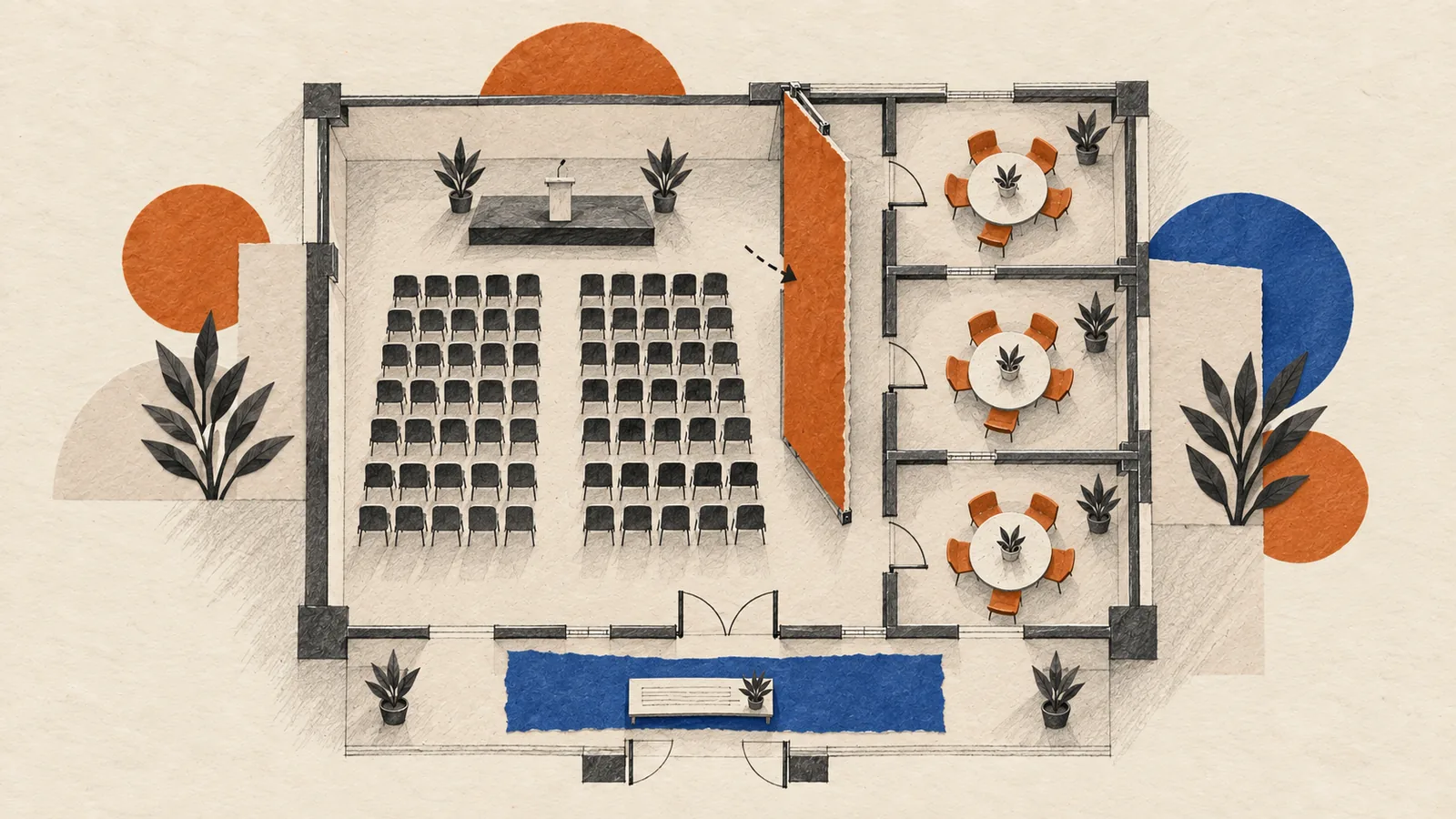
A conference venue rental in Singapore is rarely just a room. Before you compare quotes, fix your attendee numbers, seating style, session plan and event hours. Then ask each venue for a written list of what the rental includes, what it excludes, and how extra time is charged. That list, not the headline rate, tells you what the conference will really cost.
This guide covers the rental decision for conferences specifically: sizing the plenary room, planning breakouts and support rooms, reading the inclusions list, and checking permits. If you would prefer one team to shortlist venues and run the day, ask us for a conference quote.
Start with the conference format, not the venue list
A conference venue has to work for several activities at once. Delegates register, sit through plenary sessions, split into breakouts, eat, network and leave. Each activity needs space, and the venue that fits one may not fit the rest.
Write a one-page brief before you enquire. Include the date, arrival and finish times, expected headcount, plenary seating style, number of breakouts, catering moments and any exhibition or sponsor booths. Our conference brief template gives you a structure you can send straight to venues.
If you are still deciding between a conference, a seminar and a workshop, read conferences vs seminars vs workshops first. The format changes the room count, the seating plan and the length of the hire.
Size the main room by seating style
Room capacity depends on the layout. Venues publish separate figures for theatre, classroom, cluster, banquet and cocktail setups, and the gap between them is large. Theatre rows fit the most people. Classroom and cluster seating need tables, so the same room holds fewer delegates.
Singapore EXPO shows this clearly on its meeting room page. Its Peridot rooms reach up to 828 pax in a theatre setup when six rooms are combined, and its Garnet rooms reach up to 1,450 pax in theatre setup across eight rooms. Those figures assume theatre seating and combined rooms. Ask for the number in your exact layout.
Also subtract space for the stage, screens, camera platforms, a control desk and aisles. Suntec Singapore notes that its 36 customisable meeting rooms use operable walls so rooms can be sized to the event. Flexible walls help, but only if the adjoining rooms are free on your date.
Plan breakouts, support rooms and pre-function space
Most conferences need more than one room. List every space the programme needs and book them together, because adjoining rooms are often the first to go.
- Breakout rooms. Match each breakout to its expected audience, not an even split of total headcount. Popular tracks fill first.
- Speaker and VIP holding room. Speakers need a quiet place to prepare and a short route to the stage.
- Secretariat or crew room. Registration staff, AV crew and the event team need a base for equipment and printing.
- Pre-function area. Registration, coffee breaks, sponsor booths and networking usually happen outside the main hall.
Venues design for this. Singapore EXPO describes its Tourmaline rooms as well-suited for use as a secretariat room, speaker room, or VIP holding room. It also says its pre-function areas suit registration, networking, cocktail receptions and light exhibitions. Ask whether pre-function space is included with your rooms or charged separately.
A walk-through before you sign helps you test these routes. Use our event site visit checklist to check registration flow, lift access and the path from breakouts back to the plenary room.
Read the inclusions and exclusions line by line
Two quotes with similar room rates can cover very different things. Ask each venue for its inclusions list in writing and compare them side by side.
Suntec Singapore publishes a useful example. For meetings and seminars, its rental covers the use of the function space, specified seating arrangements, general room lighting & air-conditioning during event hours, water, mints and writing materials, a registration package and venue-wide complimentary WiFi. Its rental rates exclude audiovisual equipment, security or insurance, cleaning of exhibition areas, freight and utility connections.
Food is often separate too. Suntec states that Food & Beverage (F&B) services are not included in room rental. Hotels and some venues bundle catering into a per-person package instead, so check which model each quote uses before you compare totals.
Use these questions for every venue on your shortlist:
- Which rooms, pre-function areas and hours does the rental cover?
- Is setup and teardown time included, or charged as extra hours?
- What AV comes with the room, and can you bring in your own production supplier?
- Is catering in-house only, and is there a minimum spend or minimum headcount?
- What are the deposit, payment and cancellation terms?
For a fuller list of technical and operational requirements, see our corporate event venue requirements checklist.
Watch the hours in the contract
Conference days run long. Crews often need the room the night before or early in the morning, and teardown can run past the last session. If those hours are not in the contract, you may pay extra or lose setup time.
Suntec Singapore states that additional timing outside of the contracted period will be subject to charges and availability. Share your full production schedule with the venue before signing. Include load-in, rehearsal, doors open, the last session and load-out.
Plan AV and hybrid needs early
Audiovisual needs shape the room choice. A plenary with large screens, stage lighting and a livestream needs ceiling height, rigging points, power and a clear camera line. A simple breakout may only need a projector and a microphone.
Some venues include basic AV in the room. Singapore EXPO says each meeting room is equipped with modern audio-visual, lighting and technical capabilities. Even so, confirm what is included, who operates it, and whether an external production team is allowed. If remote delegates will join, read our guide to hybrid live streaming in Singapore before you lock the room.
Check licences and fire safety permits
A closed-door business conference may need few approvals, but add-ons can change that. Exhibitions, performances and public-facing elements can trigger licences or permits.
Start with the GoBusiness e-Adviser. It helps you understand which licences and permits you need to organise sports, MICE, arts/culture and/or business-to-consumer (B2C) events. Run your plan through it early, because some approvals take time.
If the conference includes an exhibition or trade fair area, check SCDF’s rules. SCDF states that if a temporary change of up to 60 days involves stage shows, promotional activities, exhibitions, trade fairs, or carnivals, a temporary change of use permit (TCOUP) is required. Ask the venue who usually applies and which fire safety conditions apply to booths and exits.
Compare purpose-built centres, hotels and unique venues
Each venue type suits a different conference.
- Convention and exhibition centres. These suit large plenaries, many breakouts and an exhibition floor under one roof. Suntec Singapore lists 12,000 sqm of exhibition space on Level 4 alongside its meeting rooms.
- Hotel ballrooms and function rooms. These suit residential or regional conferences where delegates stay on site. Packages often bundle rooms, meals and basic AV.
- Cultural and unique venues. These suit smaller conferences where the setting matters. National Gallery Singapore says its spaces are ideal for hosting a variety of events, from conferences to product launches and cocktail events.
For international delegates, ask about hotel partnerships. The Singapore Tourism Board says its SHINE programme gives meeting organisers specially negotiated room rates and benefits through partner hotels. It also describes the Singapore MICE Advantage Programme, which streamlines planning and offers benefits to delegates at supported events.
What drives the cost of a conference venue rental
Venues quote on request, and rates change with the date and demand. Instead of chasing a single figure, understand what moves your quote:
- Number and size of rooms. Plenary, breakouts, holding rooms and pre-function space all add up.
- Hours. Setup, rehearsal and teardown time can extend the hire beyond the event day.
- Catering model. Per-person packages, minimum spends and in-house catering rules change the total.
- AV and production. Screens, lighting, stage, livestreaming and crew are often quoted separately.
- Date and day of week. Peak conference months and popular weekdays fill first.
- Permits and extras. Exhibition areas, security, cleaning and insurance can add line items.
Our conference organiser guide explains what a full-service team handles beyond the venue. For the wider venue search, see what to check before you rent an event venue. When you are ready, send us your brief for a quote covering venue, production and on-the-day management.
Conference room rental in Singapore: what the rate covers
A conference room rental quote looks simple until you compare two of them. One venue quotes the room alone. Another quotes a per-person package with meals, a projector and a fixed set of hours. Before you compare totals, work out what each rate actually buys, how long you get the room for, and which items will appear later as add-ons.
Half-day vs full-day conference room rental
Most venues and hotels sell a conference room rental in half-day and full-day blocks. A half-day block usually suits a briefing, a training session or a short seminar. A full-day block suits a programme with a plenary, breaks and a lunch. Check these points for each block:
- The exact hours. Ask for the start and end time in writing. A “half day” at one venue can be shorter than at another.
- Setup and teardown. Confirm whether the block includes time for your crew to load in, rehearse and clear the room, or whether that time is charged separately.
- What the package bundles. Some packages include coffee breaks, lunch and basic AV. Others cover the room only.
- Overtime. Ask how running late is charged, and whether the room is free after your block or already booked by another group.
If your programme sits close to the edge of a half-day block, price the full day as well. Rushing a teardown to save a few hours rarely helps the event.
Room set-ups and how they affect capacity
The same room holds a very different number of people depending on the layout. Ask every venue for its capacity in your chosen set-up, then allow for the stage, screens, a control desk and aisles.
| Set-up | Best for | Space needed per guest | What to check |
|---|---|---|---|
| Theatre | Keynotes, briefings, town halls | Lowest | Sightlines to screens and the stage |
| Classroom | Training, workshops with laptops | Higher, because of tables | Power points near the tables |
| Cluster or cabaret | Group work, interactive sessions | High | Whether every seat can see the screen |
| U-shape or boardroom | Small meetings, leadership sessions | Highest | Microphones for discussion around the table |
| Banquet | Conferences with a seated meal | High | Changeover time if the room also hosts sessions |
If you need to change the layout during the day, for example from theatre to banquet, ask how long the changeover takes and whether it is included.
What “AV included” usually means
“AV included” in a conference room rental often means a basic in-house kit: a projector or screen, a small sound system and a microphone or two. It rarely means a full production. Ask the venue to list each item, how many microphones you get, who operates them, and whether a technician stays in the room or only sets up. If you need cameras, livestreaming, stage lighting or large LED screens, ask whether you can bring in your own production supplier and whether the venue charges a fee for external crew.
Extras that are easy to miss
These items are often outside the headline conference room rental rate. Ask about each one before you sign:
- Additional hours for early setup, rehearsal or late finish
- A minimum spend or minimum headcount for food and drink
- Extra microphones, clickers, flipcharts and stationery
- Technician or operator time
- Pre-function space for registration and coffee breaks
- Holding rooms for speakers or VIPs
- Venue fees for external suppliers, signage or decoration
- Parking for guests and loading bay access for crew
- Service charge and GST on top of the quoted rate
What affects your conference room rental rate
Rates are quoted on request and move with demand. The main factors are the room size and layout, the length of the block, the day of the week and time of year, whether catering is bundled or charged separately, the AV and crew you need, and how far ahead you book. Venues in high-demand business districts can fill early on popular weekdays. If you are comparing locations, our guides to conference rooms in Marina Bay and conference rooms along Orchard Road cover what to check in each area.
Booking checklist for a conference room rental
- Confirm the headcount and the seating set-up you need.
- Write down the full schedule, from load-in to load-out.
- Ask each venue for a written list of inclusions and exclusions.
- Check the AV list, the number of microphones and who operates them.
- Confirm catering rules, minimum spend and dietary options.
- Ask for the deposit, payment and cancellation terms.
- Visit the room, or ask for a floor plan with power points and exits marked.
- Compare quotes on the same basis: same hours, same set-up, same inclusions.
If you would rather hand this over, Get Out! can shortlist rooms, compare quotes line by line and run the production on the day.
Frequently asked questions
What is usually included in a conference venue rental in Singapore?
It varies by venue, so ask for a written list. Suntec Singapore, for example, lists the function space, the specified seating, lighting and air-conditioning during event hours, water, mints, writing materials, a registration package and complimentary WiFi for meetings and seminars.
What is usually not included in a conference room rental?
Food and drink, audiovisual equipment, extra hours and on-site extras are common add-ons. Suntec Singapore states that F&B services are not included in room rental and that audiovisual equipment is not included in its rental rates.
How do I choose the right room size for a conference?
Start from your seating style, not the room’s headline number. Venues publish different capacities for theatre, classroom, cluster and banquet layouts, and the same room can hold far fewer people once you add tables, a stage and a registration area.
Do I need extra rooms besides the main conference hall?
Usually yes. Plan for breakout rooms, a speaker or VIP holding room, a secretariat or crew room, and a pre-function area for registration and networking. Singapore EXPO, for example, suggests its smaller rooms as secretariat, speaker or VIP holding rooms.
Does a conference at a rented venue need a licence or permit?
Some do. The GoBusiness e-Adviser for Events helps organisers check which licences and permits apply to MICE and other events. SCDF also requires a temporary change of use permit for certain temporary uses such as exhibitions and trade fairs held alongside a conference.
Is a half-day or full-day conference room rental better value?
It depends on your programme. A half-day block suits briefings and short training sessions, while a full-day block suits a programme with breaks and lunch. Check the exact hours in each block and whether setup and teardown time are included, because overtime charges can make a half day cost more than expected.
What does AV included mean in a conference room rental?
It usually means basic in-house equipment such as a projector or screen, a small sound system and one or two microphones. Ask for the item list, how many microphones you get and whether a technician stays in the room. Cameras, livestreaming, stage lighting and LED screens are usually quoted separately.
How far ahead should I book a conference room rental in Singapore?
Book as early as your date allows, especially for popular weekdays and busy months in central business areas. If you need breakout rooms or holding rooms next to the main room, book them at the same time, because adjoining rooms are often the first to go.
Comparing providers? See RBTHOL conference alternative.